
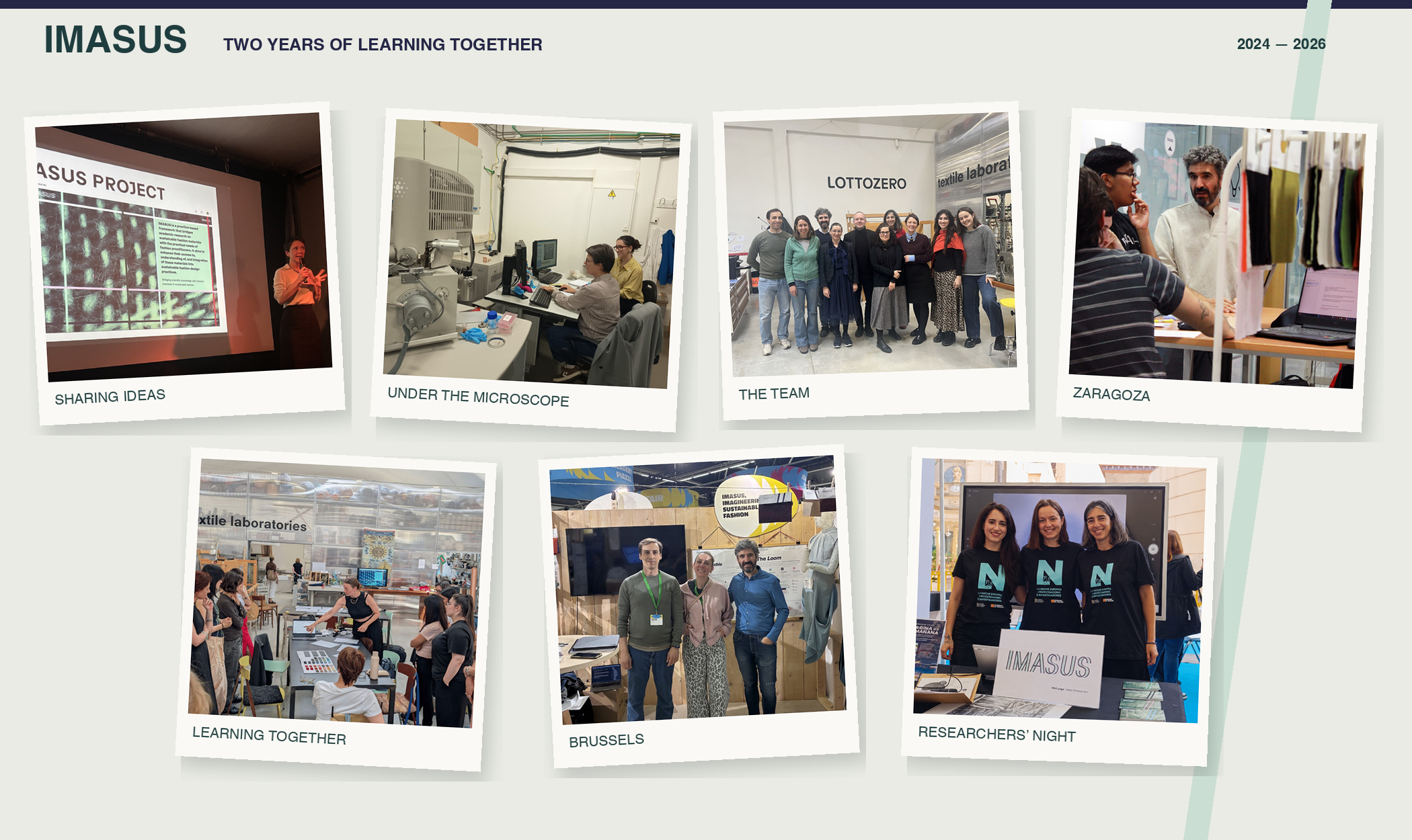
IMASUS has come to an end. We started in 2024 with a simple worry: there is a lot of good research on sustainable textiles, and very little of it reaches the people who teach and learn fashion in a form they can use. Two years later, this is the road we walked, in the order we walked it, what we leave behind, and what we take with us.
2025: we began by listening
Before building anything, we asked. Two surveys, one for universities and research centres and one for designers, brands and other people in the industry, told us three things. Knowledge is scattered across journals, closed repositories and personal networks. Verified materials are hard to find: three out of four designers and companies said so. And teachers want resources that are open, modular and available in their own language. That was our brief, and we wrote it up in the Report on Industry Needs, in four languages.
2025 and 2026: materials you can hold
The first fabric went under the electron microscope in May 2025, while the surveys were still being answered. A cloth that looks flat in your hand turns into a landscape of fibres. The survey told us what was missing, because verified materials are hard to find, but at the beginning nobody knew us, so we wrote to producers one by one. Ecoalf sent recycled polyester, fishing nets and fibres made from coffee grounds. Pyratex and Revoltech followed.
In December we opened a call for materials to everyone, and it brought 38 submissions from 21 countries. In February the first package arrived at INMA, from Torné Grup-TNTEX, and then the samples kept coming, one after another: banana production waste, an edible material, algae bioplastic, Hiblatech, Squeeze The Orange, Eeden. Each one went through the same ritual in the lab, which you can watch in a video: cut a small piece, mount it, close the vacuum chamber and wait for the beam to draw the image. From May 2025 to May 2026 we went back to the microscope again and again: wool from Prato, bioplastics made from chitosan and starch, kapok, banana skin.
By the end we had hundreds of micrographs. We chose the materials that tell a story worth teaching, wrote them up in plain language and linked them to their sources, with photographs and handling videos. Those are the 41 in the library, from 16 producers and innovators, and every one of them has been to the microscope.
What we learned here is that a data sheet is not the same as a swatch you can touch and a fibre you can see magnified. That is why we put some of the samples in an outreach kit and why a suitcase of textiles and micrographs keeps travelling to schools.
Spring 2026: learning that does not end in a PDF
With the surveys as a guide we wrote four training modules: zero waste design, design for modularity, design for recyclability and design for longevity. Each one goes from theory to a real case and a practical toolkit, and they exist in English, Spanish, Italian and Greek.
We also decided early that a PDF should not be the only form. You can read the modules online chapter by chapter, or take them as PDF, EPUB or Markdown, depending on whether you are printing for a class, reading on a phone or adapting them. We wrote about why when we published them.
April to October 2026: from “what do I design?” to “where do I act?”
The heart of the project was five workshops with 104 people: two in Zaragoza, one in Prato, one in Athens and one at the New European Bauhaus Festival in Brussels. They use the Imagineering method of Diane Nijs, in four stages: appreciating, breathing, creating and developing. Students start from real industry challenges and finish with a prototype.
The moment that repeated in every room was the second stage, when teams stop thinking about the garment and start mapping the system around it: who is involved, where materials and money flow, where a small change could move the rest. Design students are not used to that. It was what they valued most when the session ended.
What happened next surprised us. The students from the first workshop at HACER Creativo talked about their projects on Cadena SER, were filmed by Aragón TV, and showed their garments at Aragón Fashion Week and in Brussels. On 23 October we went back to the same school, with a new group, to see whether the method held on its own. It did: we told that story here.
An app anyone can run
All this knowledge needed a place to live and a way to be used in a room. So we designed a tool for it, the way you design anything: with an early prototype that we put in front of people. We used it in the first workshops, listened to teachers, students and outside reviewers, and kept iterating until it could hold the materials, the modules, the challenge cards and the whole working process of a workshop, from the first exercise to the projects the students leave behind. We had promised from the very beginning that it would be open source, and it is. You can watch the result in a four-minute screencast, or use it at app.imasus.eu.
What we take with us
- Design is iteration. We listened first, but the tools only became useful when we put an early prototype in front of people, collected their feedback and kept improving it.
- Open means usable. A licence is not enough if the format cannot be adapted, translated or printed in a classroom.
- Real material beats a slide. In every workshop and event, the thing people remembered was the thing they held.
- A method is proved when someone else runs it. The second workshop at HACER Creativo, and the organisations that have since asked for our materials, are the part we are happiest about. Among them are the Universidad Europea de Madrid, IED Firenze, HACER Creativo itself and one of the producers in our library, Fibras Naturales Canarias, which used our micrographs of its banana fibre in two vocational courses.
Take it
We said from the start that we wanted all of it to be open, and everything has a licence, listed on one page: Open by design.
- The code of the application is MIT, on GitHub and archived on Zenodo with its own DOI, 10.5281/zenodo.21476450.
- The training modules are CC BY-NC-ND 4.0, with the DOI 10.5281/zenodo.23737303.
- The workshop guide, the Report on Industry Needs, the challenge cards, the glossary and the micrographs and videos of the materials are CC BY 4.0.
If you teach, run a studio or organise a workshop, everything is ready for you. If you do something with it, tell us. That is the part of the story that is still to be written.
Thank you to everyone who sent us a sample, joined a workshop, answered a survey or opened a door. We could not have made any of this without you.