

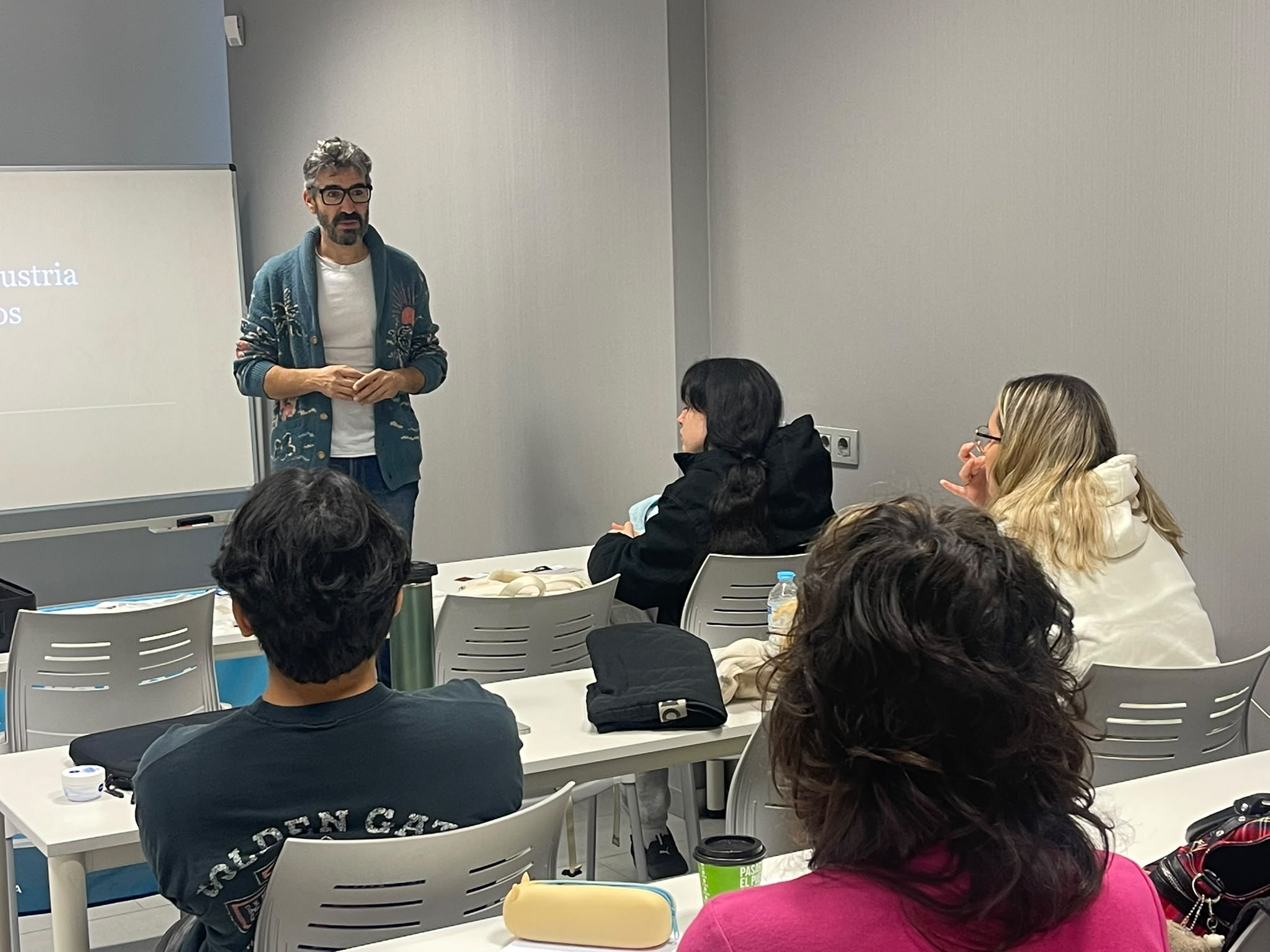
In April we ran the first IMASUS workshop at HACER Creativo in Zaragoza. Its students went on to show their garments at Aragón Fashion Week and at the New European Bauhaus Festival in Brussels. On 23 October we went back to the school with the same tools and a new group: ten third-year students, together with their teachers Cruz Burillo and Antonio Jiménez.
A second edition is a good test for a method. The first time, everything is new for everyone. The second time, you see whether the structure holds on its own, with a different group, different interests and less time to adjust on the fly.
Following the guide
We followed the sequence set out in the IMASUS Workshop Guide, in four hours: a two-hour session together, followed by two hours in which the teams worked on their own. The workshop uses the Imagineering framework in four stages: Appreciating, Breathing, Creating and Developing. Students started from the challenge cards, each one choosing the industry challenge that mattered most to them, and formed teams around those choices.
Finding the levers
Breathing is the systems stage. Mapping the actors, the material flows and the money flows around a challenge is unfamiliar for design students, who are used to starting from the garment. Once the map was on the table, the teams began to look for leverage points: the places where a small change could move the rest of the system. That shift, from “what do I design” to “where do I act”, is the core of the method, and it was what the students valued most when the session ended.
Making the change visible
In Creating, each team gave its idea a name, a promise and a guiding principle, and imagined the scenario in which that change had already happened. Putting the future on paper made the ideas concrete enough to discuss, question and improve with the rest of the group.
From idea to prototype
The physical samples from the IMASUS collection were on the tables throughout the session. Students handled them, compared them and looked at them under the microscope, and that contact with real materials fed straight into the ideas. In Developing, the teams turned their proposals into first prototypes that they could show and explain.
Two editions with two different groups at the same school tell us something useful: the method holds. The tools behind it, from the materials database to the training modules, are open for any school that wants to run it with its own students.