
One of the things I find hardest to predict when running a workshop is what happens after it ends. You design the sessions, you bring the materials, you trust the methodology, and then the students take over.
The IMASUS workshop at HACER Creativo in Zaragoza ran across two sessions in late April. Teams of students worked through the Imagineering methodology, starting from real industry challenges and arriving at concrete proposals. What I want to describe here is what came after.
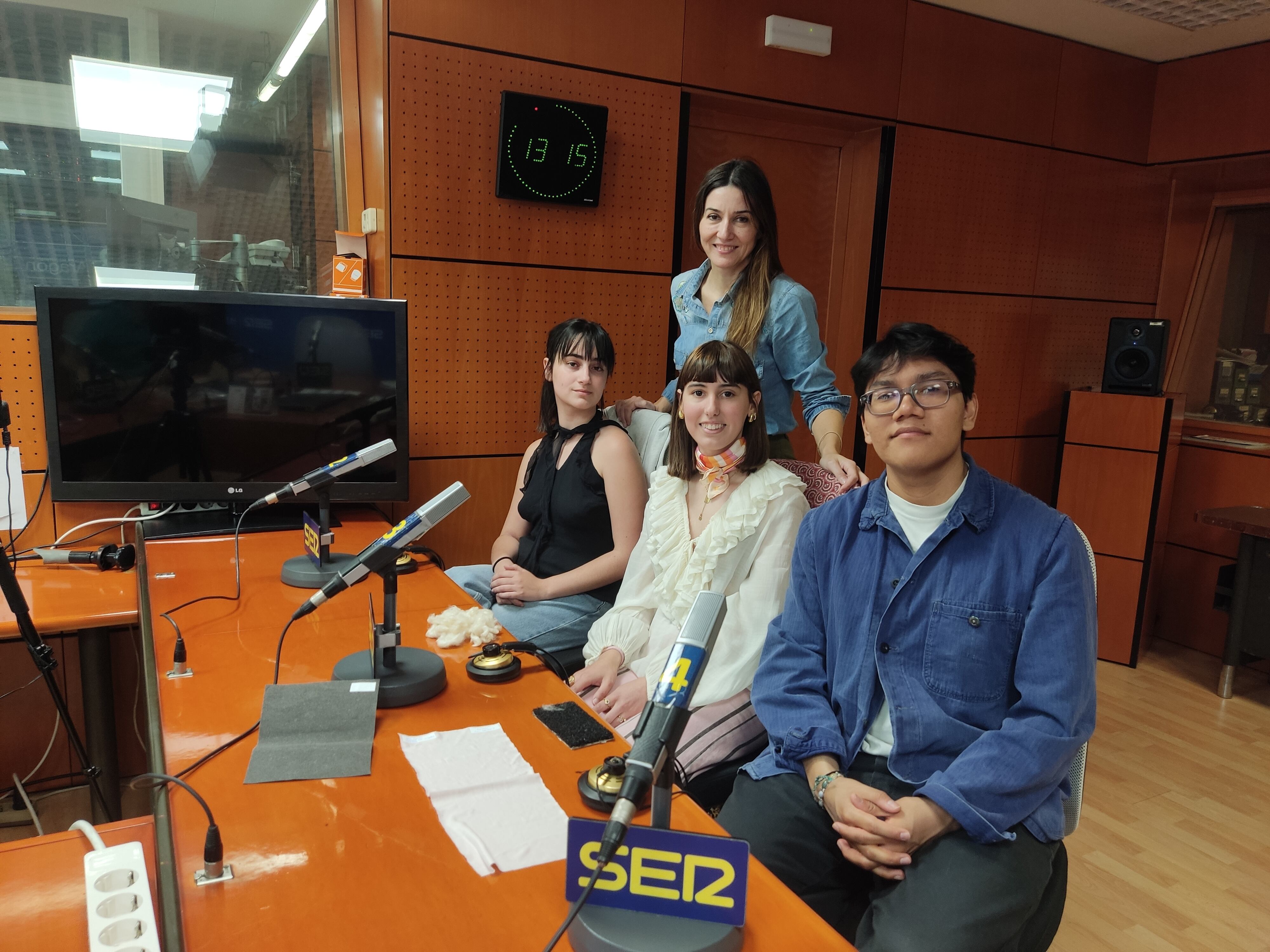
In May, the SER Sostenibles section of Hoy por Hoy Zaragoza invited us to bring the project to their weekly slot. We came with materials from the IMASUS database: a textile made from orange residues, rough-textured and flexible, from a Barcelona producer; and a kapok fibre, surprisingly soft, the kind of natural material that once filled life vests because it floats. Cruz Burillo, director of HACER Creativo, came with three students from first, second, and third year.
Each of them had been part of the workshop. Each of them had something concrete to say.
Jara, in her third year, laid out the network model her team had designed: a platform connecting emerging designers to surplus fabric from major brands, creating the collective scale that no individual recent graduate could achieve alone. She explained this clearly, in a radio studio, to an audience of thousands.
Emanuel, in his second year, talked about his own ongoing project in sustainable upcycling, and about how the workshop had helped him think through how to give it more structure and reach. He is also a member of the school’s green club, which gives some sense of how central this is to the way he works.
Daniela, in her first year, described the mango leather prototype her team had built: a hat and a bag, designed as a deliberately ephemeral collection with zero residue and zero emissions, made to exist as a single runway moment and still carry a rigorous material argument.
Cruz announced on air that work from Pilar Sicilia’s experimental pattern-making class had been selected to travel to Brussels for the New European Bauhaus Festival. The students in the studio had not yet heard which pieces had made the cut.
In June, Aragón TV sent a crew to cover the project. They filmed at the INMA laboratory with the researchers Ariana and Nansi, then moved to HACER Creativo to film Cruz and the students with the results of the workshop. That same morning, in the channel’s breakfast magazine, they connected live to Brussels, where the festival was already running. The segment aired again in the midday and evening news and circulated through the week on social media.
The garments from Pilar’s class arrived in Brussels as physical objects and were installed in the exhibition area of the New European Bauhaus Festival, running 9 to 12 June. During the panel Algorithm to Artisan on 12 June, a look by Verónica Casans came onto the stage. The session is available to watch in full.
From a workshop at a Zaragoza design school to a European festival stage in six weeks. That is not a project outcome. That is what happens when students have something real to say, and are given the conditions to say it well.
We brought the methodology. They brought everything else.