


Many research and education projects publish their results as final documents: a report, a set of PDFs, a folder of files. These formats are useful, especially for archiving and formal delivery, but they are not always the easiest way for people to learn, teach, translate, adapt, or build on what has been produced.
For IMASUS, we wanted the open knowledge base to do more than document the project. We wanted it to become a living resource: something that could be read online, reused in classrooms, referenced during workshops, translated across contexts, and extended as the project grows.
This is why the IMASUS outputs have been developed not only as deliverables, but as open digital infrastructure.
The Limits of the Final PDF
PDF is a valuable format. It preserves layout, travels well by email, and remains useful for printing, archiving, and formal reporting. IMASUS uses PDF for those purposes too.
But PDF should not be the only form of an open educational resource.
When knowledge is locked into a final PDF, it becomes harder to update, translate, search, quote, remix, or maintain. It is harder to reuse individual chapters in a classroom. It is harder to version changes transparently. It is harder for assistive technologies, search systems, and other digital tools to understand the structure of the material. A PDF can be open to download while still being difficult to work with.
Free and open-source communities have been making this point for years: openness is not only a matter of licence or access. It is also a matter of format, structure, and the practical freedom to reuse and improve the work.
Training Modules as Open Learning Material
The IMASUS training modules cover four complementary approaches to sustainable and circular textile design:
Each module includes theoretical content, a case study, and a practical toolkit. But the publication format matters as much as the structure.
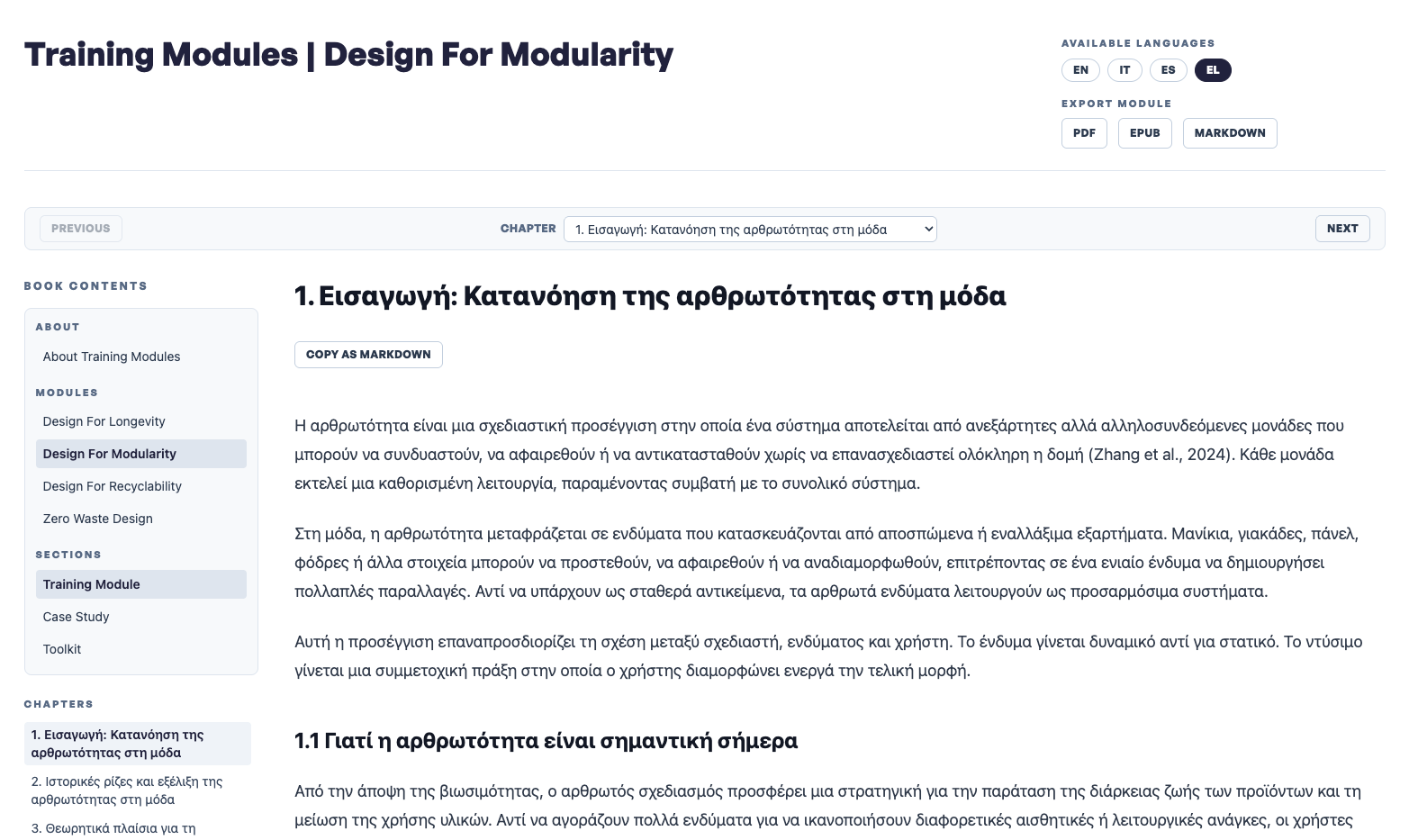
Instead of offering the modules only as static files, we published them as an interactive reader on the IMASUS website. Readers can navigate by chapter, switch language, and choose the format that fits their context:
- read online in the browser
- download PDF for printing and teaching packs
- export EPUB for offline reading
- export Markdown for adaptation and reuse
This matters because an educator preparing a workshop, a student reading on a phone, a designer collecting references, and a partner translating content do not all need the same format. Open access is not only about making something free to download. It is also about making it usable in different situations.
A Material Directory That Can Be Explored
The same principle applies to the IMASUS material directory.
The material research started as structured content: material names, origins, properties, applications, sources, and notes. But a table alone cannot fully support discovery. Designers and learners need to search, compare, filter, return to entries, and connect material information with concrete design questions.
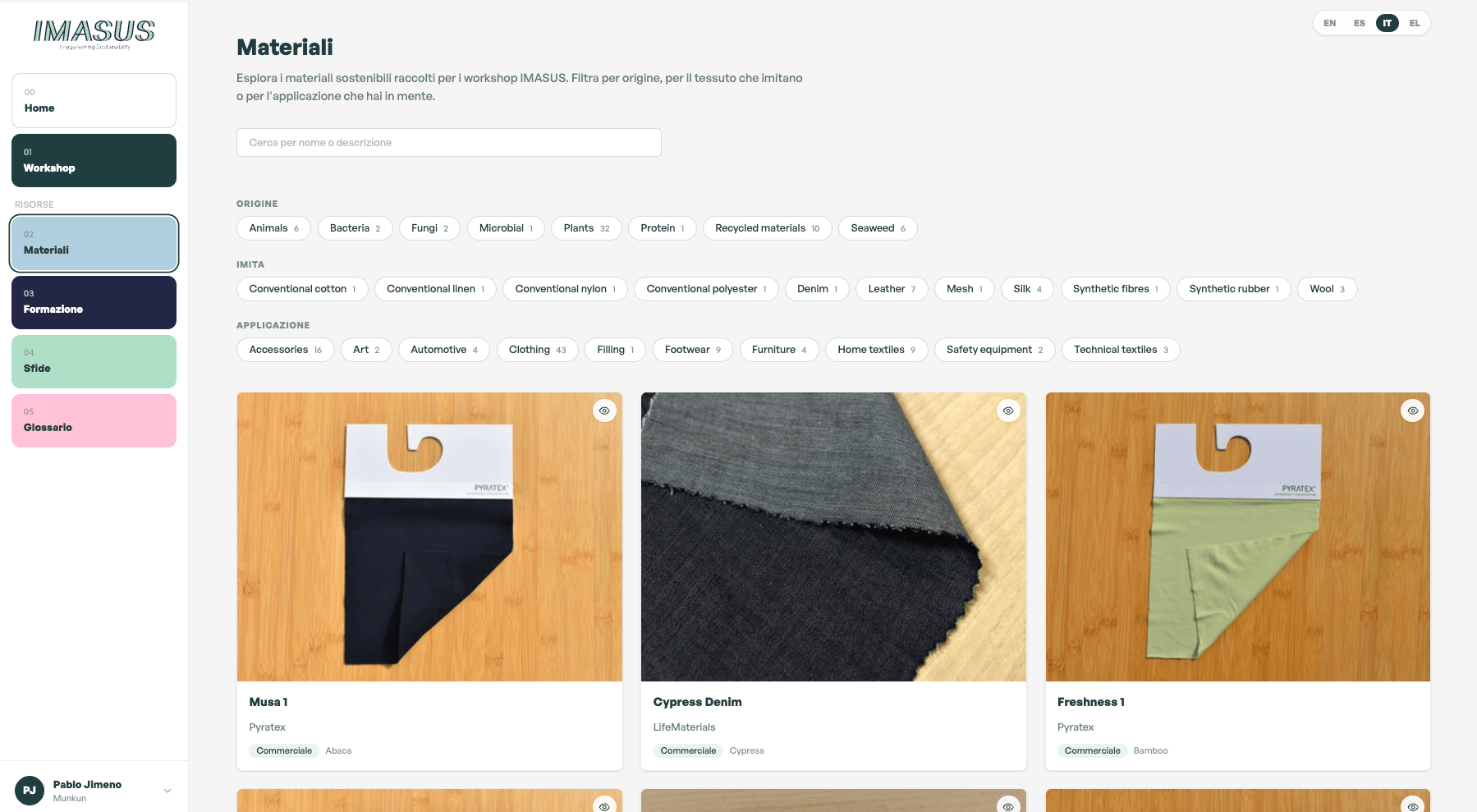
On the IMASUS platform, the material directory becomes a navigable resource. It can support teaching, workshop activities, and design exploration. It also creates a stronger bridge between scientific characterisation and practical application: materials are not only described, but placed where they can be used by learners and teams working on real challenges.
From Knowledge Base to Workshop Practice
The IMASUS platform also connects the knowledge base with the workshop methodology.
The training modules introduce key sustainable design lenses. The material directory gives access to specific material references. The challenge cards translate industry needs into design prompts. The workshop structure then brings these resources together through the Imagineering approach: appreciating what already exists, understanding the wider system, creating a shared direction, and developing proposals that others can join.
This connection is important. A knowledge base has more impact when it does not remain separate from practice. In IMASUS, the resources are designed to be used before, during, and after the workshops: for preparation, team formation, project development, process documentation, and final publication.
Why Format Is Part of Accessibility
Accessibility is often discussed in terms of interface design: contrast, typography, navigation, keyboard access, and readable layouts. These are essential. But format is also part of accessibility.
When educational content is available as HTML, it can be linked, searched, translated, indexed, and read with assistive technologies. When it is also available as PDF, it can be printed or shared as a teaching pack. When it is available as EPUB, it can be read offline. When it is available as Markdown, it can be adapted, remixed, versioned, and preserved with minimal technical friction.
Structured, semantic, open formats also make the resources easier to process with emerging tools, including translation workflows, search systems, and AI-assisted learning or research environments. This does not replace human teaching or interpretation. It simply makes the knowledge base more portable and more useful.
Open Source, Open Access, Open-Ended
The IMASUS platform has been built as open-source software and deployed as a public resource. This reflects a broader commitment: project results should not disappear into a closed folder after delivery. They should remain accessible, inspectable, maintainable, and useful for people beyond the original consortium.
That does not mean the work is finished. A living knowledge base needs care. Links need to be checked. Materials need to be expanded. Translations need review. Feedback from workshops needs to be integrated. New examples and case studies can be added over time.
But this is exactly the point. The legacy of IMASUS is not only a set of completed outputs. It is a structure that can keep supporting learning, teaching, experimentation, and collaboration in sustainable fashion.