
1. Introduction to Zero Waste Fashion Design
Zero waste fashion design addresses one of the most immediate and measurable forms of inefficiency in the apparel industry: material loss during garment production. By shifting attention to the cutting and patternmaking stages, this approach challenges conventional manufacturing logic and reframes waste as a design problem rather than a production inevitability.
1.1 Learning Objectives
By the end of this module, learners should be able to:
-
Define zero waste design as a pattern-making and systems-based approach
-
Explain the environmental significance of pre-consumer textile waste
-
Identify construction and layout strategies that eliminate or reduce cutting waste
-
Analyse the relationship between material efficiency, form, and aesthetics
-
Evaluate the practical and industrial limitations of zero waste implementation
-
Develop a garment concept using zero waste design principles
1.2 Definition and Scope
Zero waste fashion design refers to a design approach in which garments are conceived, patterned, and constructed with the explicit goal of preventing textile waste during the cutting and sewing stages (Rissanen & McQuillan, 2016). In conventional fashion systems, textile waste occurs predominantly at two points in the product lifecycle: pre-consumer and post-consumer phases. Pre-consumer waste includes offcuts, flawed fabrics, and surplus materials generated during manufacturing before a garment reaches the wearer. Post-consumer waste refers to discarded clothing at the end of its useful life.
Pre-consumer waste is particularly significant. Approximately 25% of resources are lost at the production stage, much of it due to traditional pattern-cutting techniques that leave 15–30% of the fabric unused (Blum, p. 15). These offcuts are typically downcycled, incinerated, or landfilled. Downcycling reduces fiber value because mechanical recycling shortens fiber length: for example, when wool garments are shredded and repurposed as cushion filling. Because these processes downgrade rather than preserve material quality, preventing waste at the design stage is far more sustainable than recycling after the fact.
1.3 Environmental Context and Industry Impact
This challenge is magnified by the environmental impact of the fashion and textile industry, one of the largest waste-producing and resource-intensive sectors globally. Enormous quantities of water, energy, and chemicals are consumed during fiber cultivation and textile production. Cotton, although natural and biodegradable, requires substantial water and pesticide use, and can release methane and chemical residues as it decomposes. Polyester—currently the world’s most widely produced fiber—is valued for its durability, but it is derived from fossil fuels, sheds microplastics, and can take centuries to break down. The combination of increasing global fiber production and declining material value intensifies the urgency for textile efficiency at the design stage.
1.4 Zero Waste as Design Intervention
Against this backdrop, zero-waste fashion design represents a critical intervention. It differs from general “waste reduction” because it aims not to minimize waste but to eliminate it entirely. Zero-waste designers incorporate waste-avoidance strategies beginning at the earliest moment of the design process. Waste is not treated as an afterthought to be managed at the end of production; instead, it becomes a foundational design parameter that shapes silhouette, pattern geometry, garment structure, and material selection.
Zero-waste patternmaking often requires arranging pattern pieces like a puzzle within the fabric’s width and length, using every centimeter of material. This process demands close attention to fabric dimensions, grain direction, and construction logic. As a result, zero-waste design becomes not only a technical method but also a creative and aesthetic approach—one that treats the garment, pattern, and fabric as an integrated whole. It is simultaneously a mindset, a methodology, and a design philosophy that challenges traditional notions of fashion production and encourages designers to consider material responsibility from the start.
2. Historical & Cultural Roots
Zero-waste design is often presented as a contemporary sustainability strategy, yet its principles predate industrial fashion by centuries. Many historical clothing traditions emerged from material scarcity, labour intensity, and cultural values that prioritised care and preservation.
2.1 Pre-Industrial Material Logic
Before industrialisation, clothing production was labour-intensive and highly skilled. Spinning, weaving, and sewing were done by hand, often within households, and textiles were valuable commodities (Waddell, 2004). As a result, garments were carefully made and rarely discarded. Many traditions developed techniques that avoided waste by necessity. These practices demonstrate that zero-waste design is not new, but rooted in long-standing material awareness.
2.2 Whole-Cloth Garments and Draped Construction
Across many regions, garments were created from whole pieces of fabric requiring little or no cutting. In ancient Greece, the himation, chiton, and peplos consisted of rectangular cloth wrapped or folded around the body. Similarly, the sari in India is a continuous length of fabric shaped entirely through draping. In these traditions, fabric itself defines the silhouette, with minimal alteration.


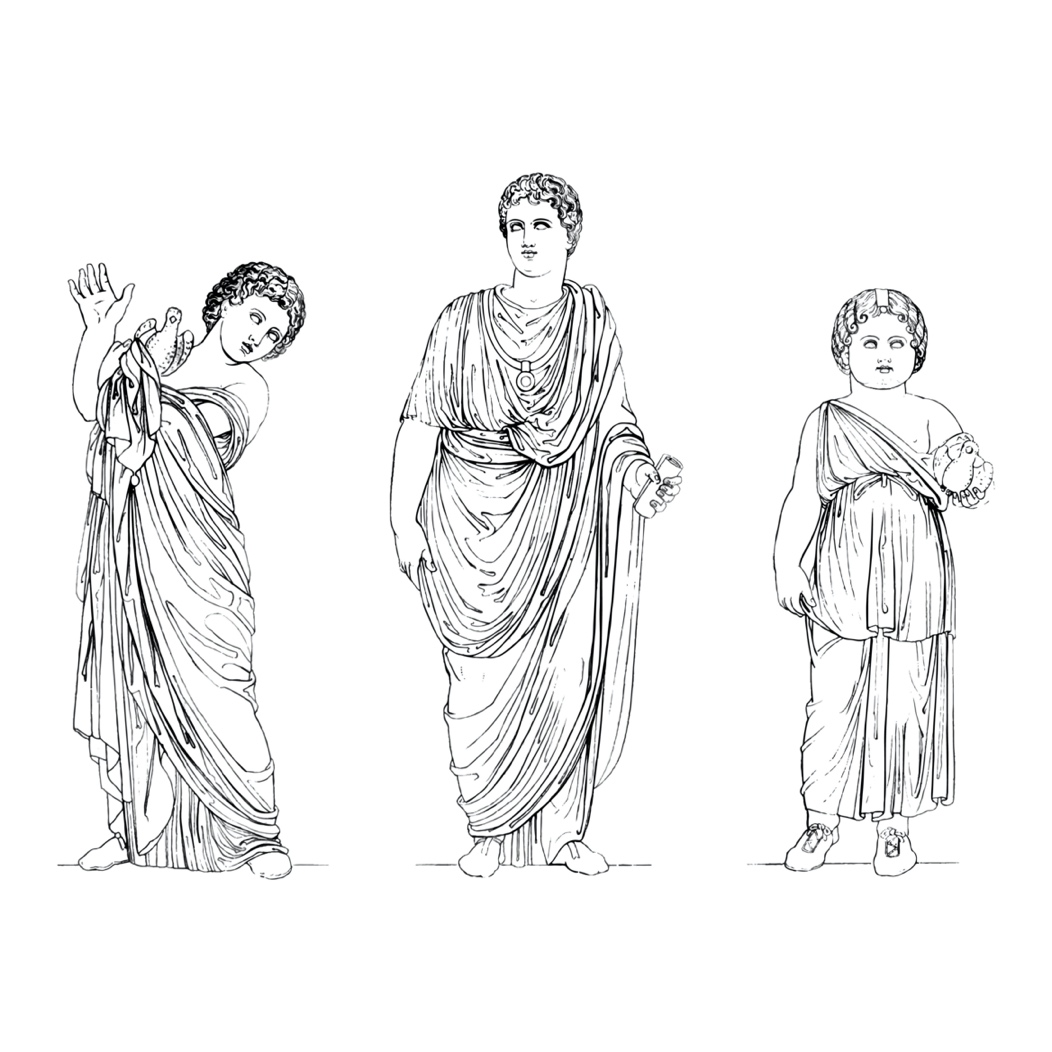
Images 1-3: kimono, sari, ancient Greek robe. Images retrieved from freepik.
2.3 The Kimono as Structured Zero-Waste System
The Japanese kimono is one of the most frequently cited examples of zero-waste construction. It is composed of straight, uniform panels cut from narrow-width fabric; shaping is achieved through folding and seam placement rather than curved cutting. Because pattern pieces derive directly from the width of the woven bolt, irregular offcuts are avoided and nearly all fabric is used (Rissanen, 2013; Rissanen, 2022). In this system, textile dimensions determine garment dimensions, illustrating how material constraints guide design decisions.
2.4 Repair, Reuse, and Patchwork Traditions
Not all traditions eliminated waste through pattern planning alone. Many cultures extended textile life through repair, patchwork, and reconfiguration. Japan’s boro textiles—garments repeatedly mended with layered patches and sashiko stitching—reflect both necessity and values of care and resourcefulness. In parts of Africa, textile traditions incorporate patchwork assemblies of repurposed cloth. In the United States, quilting developed as a method of salvaging small fabric remnants and recombining them into larger patterned forms. These examples show how labour investment and cultural meaning encouraged preservation rather than disposal.
2.5 Industrial Disruption and the Normalisation of Waste
Industrialisation transformed textile production. Mechanisation increased speed, lowered costs, and shifted perceptions of textiles from scarce to abundant. As ready-made clothing became accessible, fashion cycles accelerated and garments lost long-term value. Efficiency in volume replaced careful cloth utilisation. Pattern cutting became detached from textile dimensions, and offcuts were accepted as unavoidable by-products of mass production.
2.6 Twentieth-Century Revivals and Design Experimentation
Zero-waste principles resurfaced in the 20th century through experimental design. Ernesto Thayaht’s 1920s “Tuta” jumpsuit was cut from a single piece of fabric. Mid-century designers such as Claire McCardell and Bernardo Rudofsky explored simplified construction and reduced cutting. In the 1970s, Zandra Rhodes created garments shaped directly by textile prints. In the 1980s, Yeohlee Teng treated fabric dimensions as primary design constraints—an approach later documented in Yield: Making Fashion Without Waste (McQuillan & Rissanen, 2011).
These historical examples show that zero-waste design is both traditional and evolving. A consistent theme emerges: when textiles are valued, design methods maximise material use. Contemporary zero-waste fashion builds on these principles, combining historical knowledge with modern patternmaking, digital tools, and systems thinking to address today’s environmental challenges.
3. Redefining The Fashion Hierarchy for Zero-Waste Design
Historically, the fashion system has operated through a vertical hierarchy in which each stage of garment creation—design, patternmaking, grading, cutting, sewing, and production management—is separated into distinct roles. Since the early twentieth century, industrialisation has reinforced this division of labour in pursuit of efficiency (Rissanen, 2022). While this model improved speed and scalability, it also created rigid boundaries between creative and technical stages, producing a linear flow of decision-making from concept to production.
At the top sits the creative director, who defines artistic vision and brand direction but is typically removed from technical execution. The fashion designer translates this vision into garments, selecting materials, silhouettes, and details. The patternmaker converts sketches into two-dimensional structures, determining fit and proportion through specialised knowledge of the body and fabric behaviour. The grader expands patterns across size ranges; the cutter transfers them to fabric; the sewer assembles the garment. After rounds of sampling and refinement, production moves to industrial scale under the supervision of a production manager.
In this conventional structure, each role depends on prior decisions, with limited feedback across stages. Because garments are rarely designed with the cutting layout (marker) in mind, fabric waste is largely determined by early design choices—the number and shape of pattern pieces, size range requirements, and marker efficiency (Rissanen, 2022). This separation of design and cutting logic directly contributes to material waste.
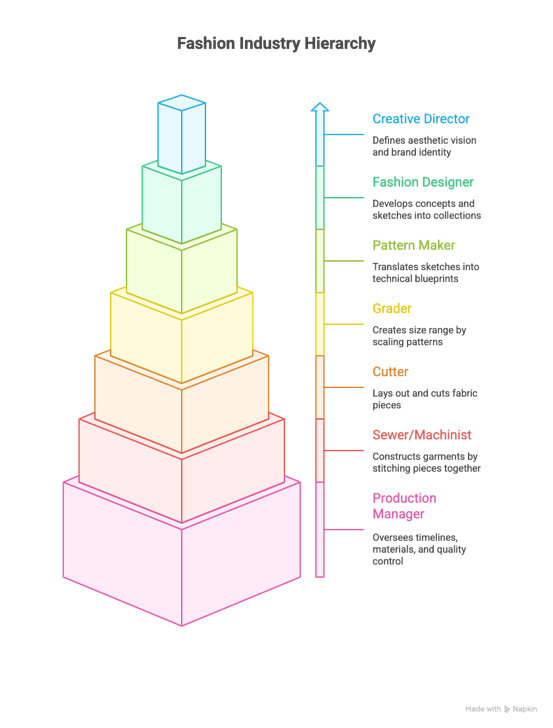
Figure 1: Illustration representing the division of roles in the fashion hierarchy. Illustration created by the author using Napkin.
3.1 Shifting from Hierarchy to Systems Thinking
Zero-waste fashion design challenges this linear model. Rather than treating design and production as separate steps, it frames them as interconnected processes in which designers, pattern cutters, graders, and manufacturers hold equal importance. This requires moving away from sequential decision-making toward a systems-based approach where silhouette, textile choice, pattern geometry, and production feasibility are considered simultaneously.
As Rissanen and McQuillan argue, the designer’s role expands beyond stylist or sketch author to systems thinker—someone who understands how material use, manufacturing processes, commerce, wearer behaviour, and end-of-life outcomes intersect (McQuillan & Rissanen, 2011; Rissanen, 2022). In zero-waste practice, thinking, designing, and making cannot be separated.
Adopting this mindset is a key point of intervention. A systems-oriented approach reframes fashion’s role in society by encouraging responsible relationships between designers, producers, and users.
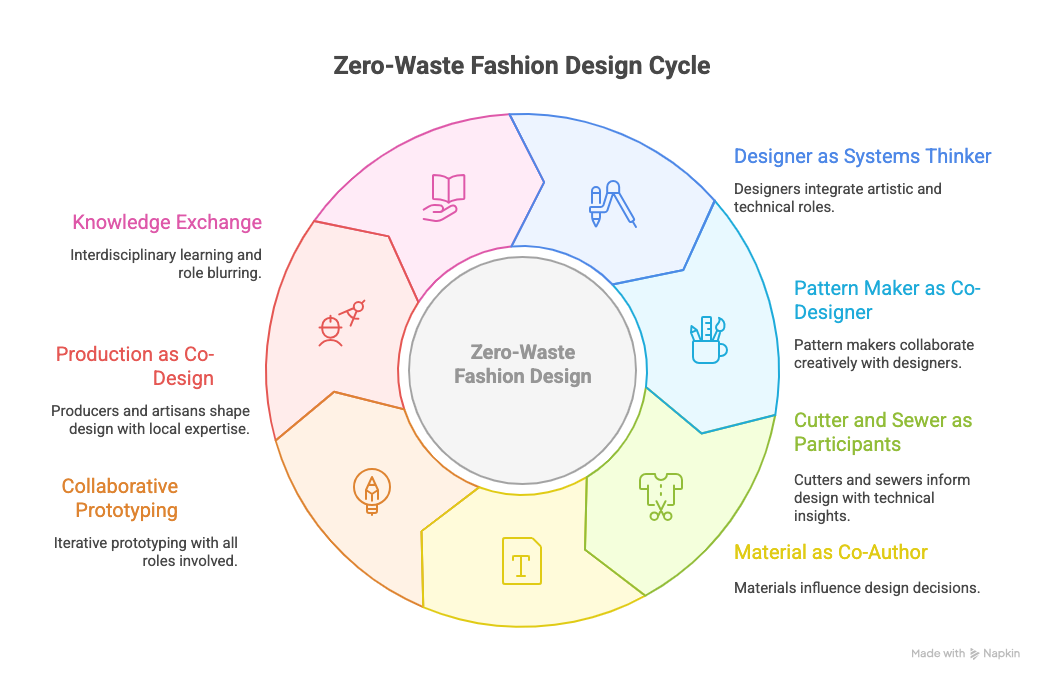
Figure 2: Representation of a zero-waste fashion system. Illustration created by the author using Napkin.
3.2 Critical Making as a Design Approach
Fashion education often prioritises sketching as the starting point of design. Zero-waste design, however, aligns more closely with critical making—a practice that connects conceptual exploration with hands-on experimentation (Ratto, 2011; McQuillan, Rissanen & Roberts, 2013). Critical making values iterative prototyping and reflection, recognising that knowledge emerges through the act of making rather than from a predetermined final image.
This approach reframes garment development as a dialogue between designer, textile, and form. Unexpected results—misalignments, structural tensions, unconventional shapes—can become creative opportunities. As Roberts notes in subtraction cutting, “carefulness and precision are no guarantee of successful outcomes”; it is often when a garment “goes wrong” that new possibilities emerge (Roberts, 2021).
By emphasising process rather than fixed aesthetics, zero-waste design reveals elements usually hidden in fashion production: textile structure, pattern logic, and the designer’s intervention. Nothing is removed; instead, as McQuillan and Rissanen suggest, it is “an absence of absence” (2011).
3.3 Zero-Waste Fashion Design Practices
Zero-waste practices are grounded in the principle that fabric and form are inseparable. The primary constraint in zero-waste patternmaking is the requirement to use 100% of the fabric width, whether within a single garment or across multiple pieces (McQuillan, 2020). This shifts pattern cutting from a technical afterthought to a central component of concept development (Sinha, in ElShishtawy et al., 2022).
Because adjustments to one pattern piece affect all others, zero-waste patternmaking requires integrated knowledge of draping, construction, and textile behaviour. Outcomes are not fully predictable, and iterative experimentation becomes essential.
This exploratory process often produces forms that differ from conventional sketch-led designs. Pattern cutting becomes generative: the cut initiates design rather than merely executing it.
3.4 The Zero Waste Fashion Design Process
Zero-waste design is supported by a systems-based framework that considers interrelated constraints: brand identity, sustainability goals, resource use, production capacity, labour skills, grading requirements, and yield efficiency (McQuillan, 2019). These factors shape which zero-waste strategies are appropriate in a given context.
Five essential criteria must be balanced for a zero-waste garment to succeed (Rissanen, 2022):
-
Appearance: The garment must remain visually compelling; aesthetics cannot be sacrificed for waste reduction alone.
-
Fit: Comfort, movement, and body–garment relationships must function properly.
-
Cost: Strategies must support realistic pricing and avoid unnecessary increases.
-
Sustainability: Fibre selection, durability, and potential future transformations must align with environmental goals.
-
Manufacturability: The garment must be feasible to produce; zero-waste design has limited value if it cannot be constructed effectively.
Together, these criteria ensure that zero-waste design is not a purely technical exercise but an integrated strategy balancing form, function, and material responsibility.
4. Zero Waste Fashion Design Methods
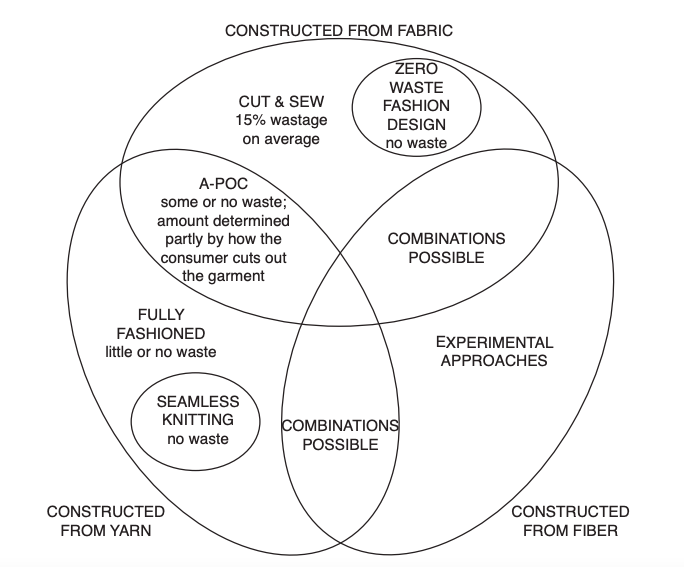
Zero-waste fashion design can be developed through several garment construction systems. Rissanen (2022) categorises fashion creation into three broad areas: garments constructed from fabric (cut-and-sew systems, including zero-waste patternmaking); garments constructed from yarn (fully fashioned and seamless knitting); and garments constructed directly from fibre (such as felted or moulded forms). These systems are not mutually exclusive, and hybrid approaches are increasingly common. In this module, zero waste refers specifically to cut-and-sew garments made from fabric, where the main objective is eliminating waste during the cutting stage.
Figure 3. Illustration by Timo Rissanen depicting fashion creation methods from a fabric waste perspective. Three broad fashion creation approaches exist, but combinations of these are also possible (Rissanen, 2022).
4.1 Design Approaches in Zero-Waste Fashion (Rissanen’s Nine Approaches)
Rissanen (2013) identifies nine common design sequences that show how garments can begin from different entry points—sketching, draping, textile print layout, conceptual ideas, existing garments, or photographs. These sequences demonstrate that zero-waste design is not tied to a single linear process. Designers may move between 2D and 3D stages multiple times, refining ideas in response to material constraints.
-
Sketch → Pattern → Toile → (Design alteration) → Pattern alteration → Sample garment
-
Pattern → Toile → (Design alteration) → Pattern alteration → Sample garment
-
Sketch → Draping → Pattern → Toile → (Design alteration) → Pattern alteration → Sample garment
-
Draping → Pattern → Toile → (Design alteration) → Pattern alteration → Sample garment
-
Conceptual idea → Pattern → Toile → (Design alteration) → Pattern alteration → Sample garment
-
Textile print on paper → Draping paper on body → (Sketch) → Pattern → Toile → (Design alteration) → Pattern alteration → Sample garment
-
Existing garment → Sketch → Pattern → Toile → (Design alteration) → Pattern alteration → Sample garment
-
Existing garment → Pattern → Toile → (Design alteration) → Pattern alteration → Sample garment
-
Photograph of garment → Pattern → Toile → (Design alteration) → Pattern alteration → Sample garment
The importance of these sequences lies in recognising patternmaking as a flexible design tool rather than a purely technical step. Zero-waste practice often moves back and forth between flat pattern and three-dimensional form. Fabric width, geometry, and layout logic are considered early in development. The process is iterative, with multiple possible pathways leading to a final garment.
4.2 Constructed from Fabric: Patternmaking Methods
Zero-waste patternmaking integrates pattern development into the earliest stages of design. Instead of sketching first and drafting later, designers work simultaneously with silhouette, fabric width, and geometry (McQuillan, Rissanen & Roberts, 2013). Fabric width becomes a defining constraint that shapes the garment (Rissanen, 2022). Pattern pieces are arranged to eliminate negative space on the marker, often using geometric forms—rectangles, squares, and straight lines aligned with the woven structure.
Because each pattern piece affects the others, adjustments often require changes across the entire layout. This demands spatial awareness and flexibility. Designers may adapt conventional blocks—bodices, sleeves, skirts, trousers—but ensure each piece includes seam allowance and fits within a waste-free configuration. As Almond (2010) notes, this approach requires both technical precision and conceptual openness. Patternmaking becomes a generative stage of design rather than a secondary one.
4.3 Zero Waste Pattern Making Techniques
4.3.1 Subtractive and Additive Cutting
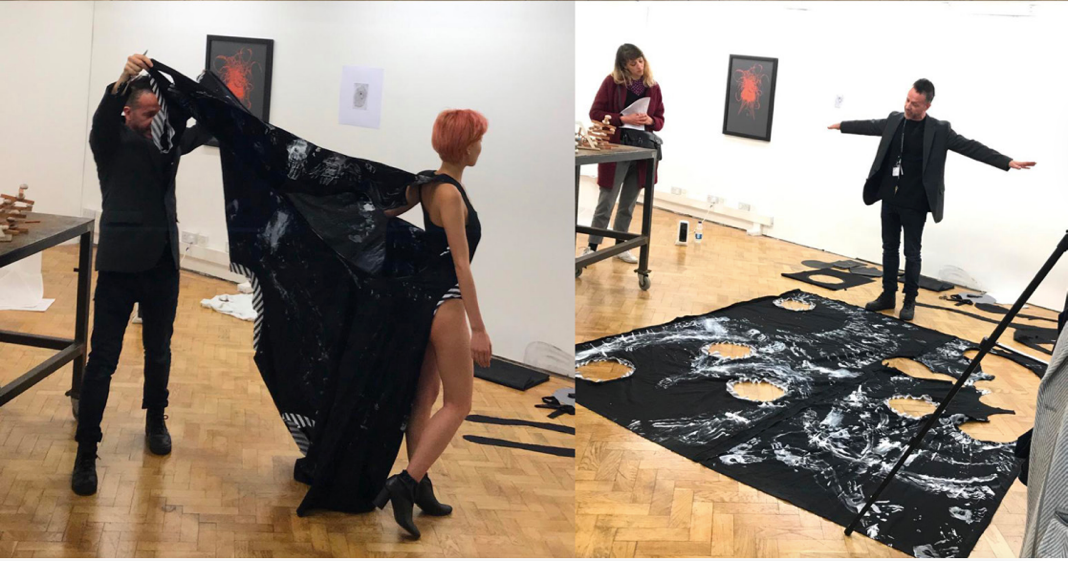
Subtractive cutting, developed by Julian Roberts, focuses on creating internal voids through which the body moves rather than defining the outer silhouette. Large panels are cut with openings that fold and drape around the body (McQuillan, Rissanen & Roberts, 2013). Because much of the cloth remains intact and removed shapes are reused, waste is minimal.
The technique accepts unpredictability. Designers guide the process by adjusting openings and seam relationships rather than fully controlling the final form. Roberts’s “plug” method—where any shape can fill any opening if seam lengths match—demonstrates the system’s flexibility. Although often sculptural, subtractive cutting shows how zero-waste design can produce complex forms without conventional cut-and-sew logic.
Image 4: The Pluto Dress, by Julian Roberts created in collaboration with Mari Bendeliani, exhibited and later dissected live to reveal a painting concealed inside. The performance took place during the practitioner talk at the Speed of Thought exhibition, Newington Gallery, The Art Academy London, UK, November 2019. (Julian Roberts’s Portfolio)

4.3.2 Minimum-Cut, Minimum-Seam, Origami, and Geometric Cutting Methods
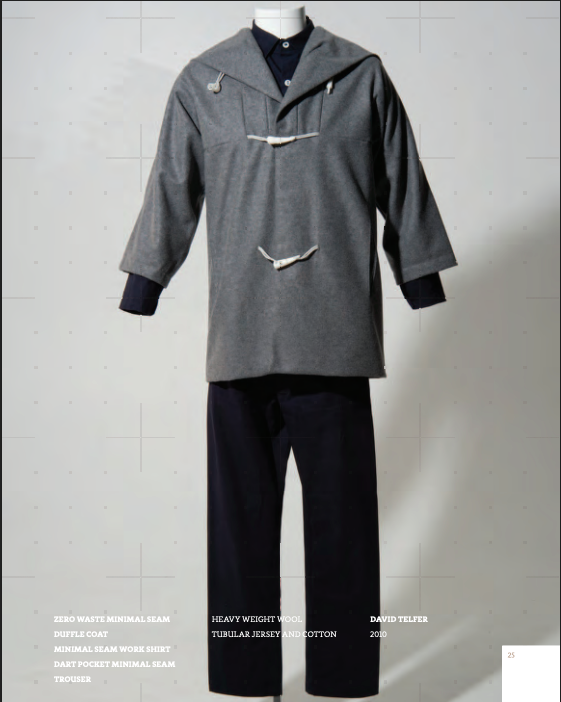
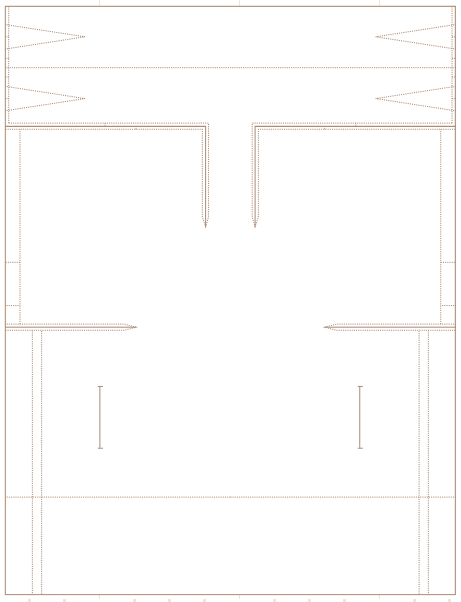
Minimum-cut methods aim to reduce the number of cuts and seams, relying instead on folding, layering, and geometric shaping. Designers often use large rectangular panels, forming garments through tucks, pleats, slashes, and drawstring channels (Rissanen, 2022). This preserves more fabric and leverages natural drape and grain direction.
Structured silhouettes can still be achieved. Designers such as David Telfer demonstrate how selective seam placement and geometric logic produce refined forms (McQuillan & Rissanen, 2011). Interlocking gores, gussets, and folded edges can replace curved seams and darts. These systems show how constraint can drive innovation while reducing offcuts.
Image 5: Minimum seam duffle coat, work shirt and trousers, along with the zero waste pattern designed to create them, created by David Telfar in 2010 and shown in the Yield exhibition (McQuillan& Rissanen, 2011).
4.3.3 Transformational Reconstruction
Transformational Reconstruction (TR), developed by Shingo Sato, merges patternmaking and three-dimensional design. Starting with a basic block on a dress form, designers draw new style lines directly onto the toile (El-Dosuky, 2023). These lines are cut, flattened, and reassembled to integrate shaping into seam lines (ElShishtawy, Sinha & Bennell, 2022).
While not inherently zero-waste, TR aligns with its principles because it reshapes rather than removes material. Pattern pieces can be engineered to interlock efficiently. TR allows sculptural and expressive forms while maintaining structural control, making it a useful complement to zero-waste layout strategies.
Sato developed several TR techniques:
-
Dart TR: Relocates darts by redrawing shaping lines and integrating them into new seams.
-
Vortex TR: Creates swirling volumes by radiating lines around a cone-like structure.
-
Balloon TR: Produces rounded forms by duplicating and spreading curved pieces.
-
Architectural TR: Incorporates geometric modules into the garment structure.
-
Accordion TR: Duplicates and spreads elements to create layered, fan-like effects.
These techniques allow varied silhouettes to emerge from a single block through manipulation rather than removal.
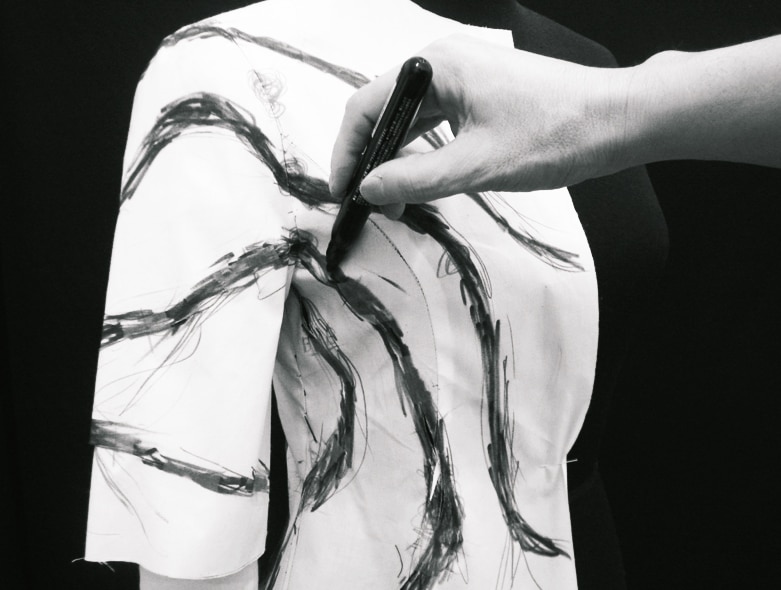
Image 6: Transformation reconstruction pattern development retrieved from https://www.muellerundsohn.com/app/uploads/2018/08/Shingo-Sato-Wellenjacke-naehen_MuellerundSohn_Step1.jpg
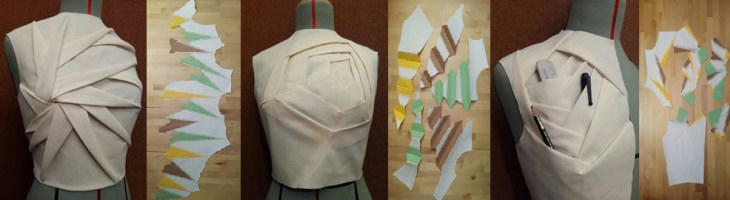
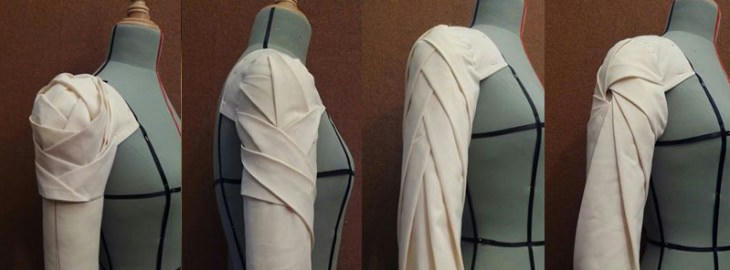
Image 7: Transformation reconstruction techniques used to make a bodice and a sleeve, retrieved from https://asiastage.mx/el-transformational-reconstruction-de-shingo-sato/
4.3.4 Jigsaw Method
The jigsaw method uses interlocking pattern shapes that fill the entire fabric area without gaps (Binde & Freimane, 2022). Unlike tessellation, it does not rely on repeating identical units; varied shapes are allowed, offering greater flexibility.
This method requires strong spatial reasoning. A curve in one piece must correspond to its neighbouring piece, and changes to one shape affect the entire layout (Sinha, in ElShishtawy et al., 2022). Jigsaw logic can be built from scratch or integrated into conventional patterns, making it adaptable to both experimental and commercial contexts.
4.3.5 Tessellation
Tessellation, developed by Holly McQuillan, uses a single repeating shape that tiles the fabric without gaps (McQuillan, 2019). Multiple layers are cut from this repeating unit, creating modular components that can be assembled in various configurations.
The modular structure allows transformability and part replacement (Pingki, Hasnine & Rahman, 2019). However, the shape must tile precisely to the selvage; otherwise, waste occurs (Sinha, in ElShishtawy et al., 2022). Tessellation is powerful conceptually but may be more suited to experimental or limited-production contexts.
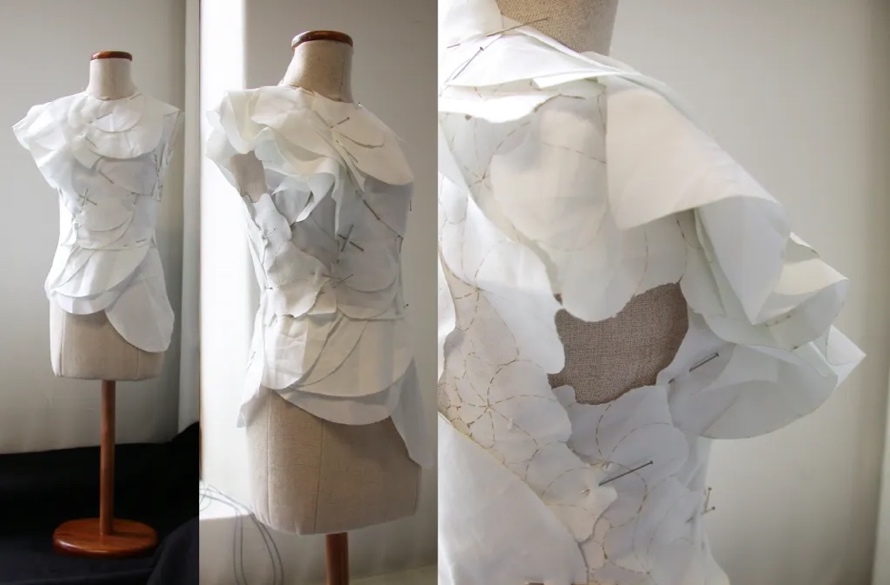
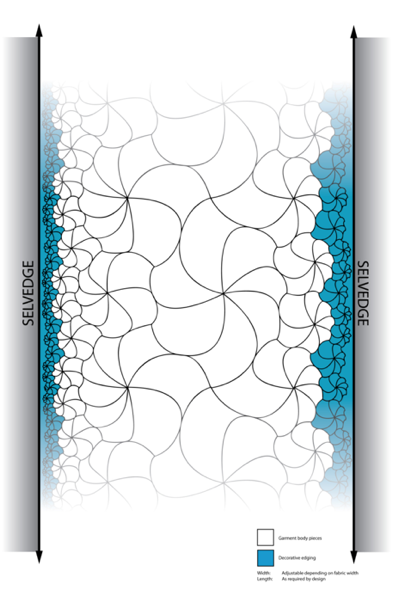
Image 8: Zero-waste tessellation top by Holly McQuillan. White shapes indicate garment body components; blue shapes indicate decorative edging (McQuillan, n.d.).
4.3.6 Creative Cut
Creative Cut transforms typographic forms—letters or words—into pattern pieces. Designers cut apart a word and reassemble its fragments into garment shapes. Because all pieces are incorporated, layouts can achieve zero waste.
This method encourages experimentation and direct testing on the body or dress form (Roberts Portfolio, 2019). It challenges conventional assumptions about shape and reinforces the principle that every cut piece has value.
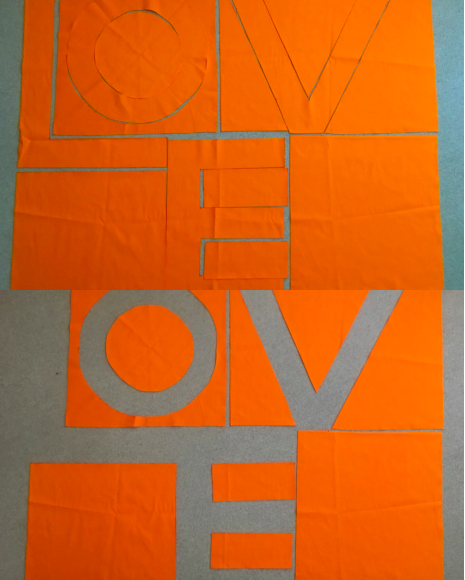
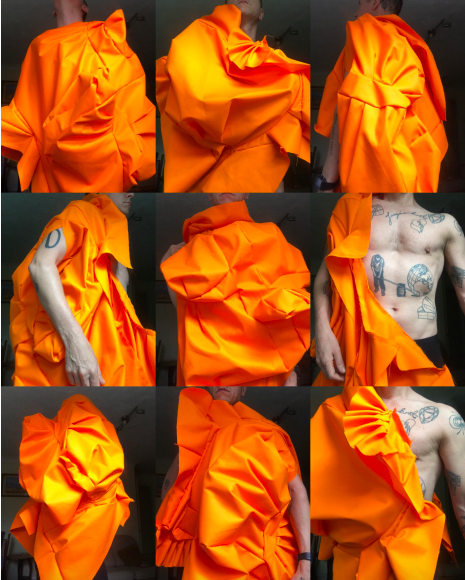
Image 9: Typographic cutting demonstration by Julian Roberts for the Body Language masterclass, showing how the word “LOVE” is transformed into a set of pattern shapes explored on the designer’s body (Roberts Portfolio, 2019).
4.4 Integration with Technology
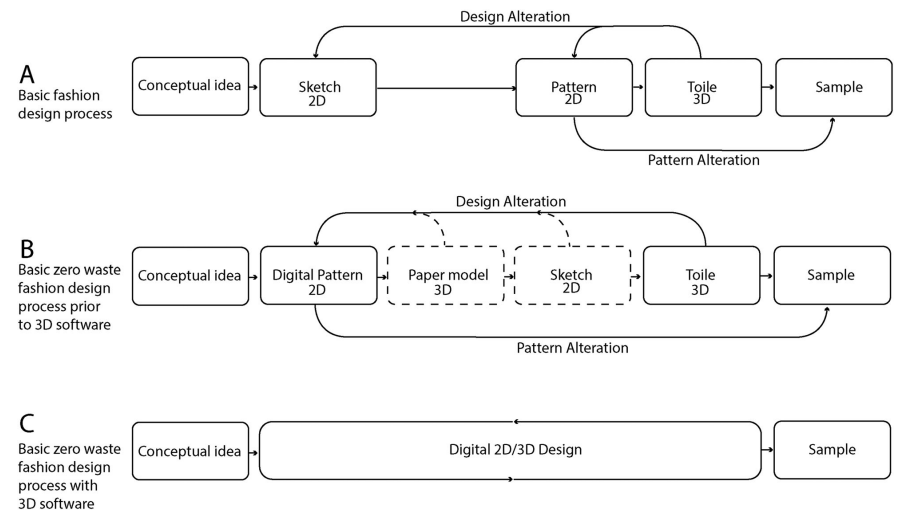
Digital tools support zero-waste design by allowing layouts to be tested before physical cutting. Software such as CLO3D, Browzwear, and Optitex visualises the relationship between 2D patterns and 3D form (McQuillan, 2020). This reduces physical sampling, which can waste significant fabric during development (Waddell, 2004).
Digital fabric simulation helps designers anticipate drape and behaviour in complex layouts. While not yet perfect, emerging AI-assisted modelling improves prediction accuracy. These tools strengthen the connection between pattern logic, material performance, and garment construction.
Figure 4. Diagrams created by Holly McQuillian (2020) showing (A) the basic fashion design, (B) a basic zero-waste design process without 3D tools and (C) a basic zero-waste design process using 3D tools.
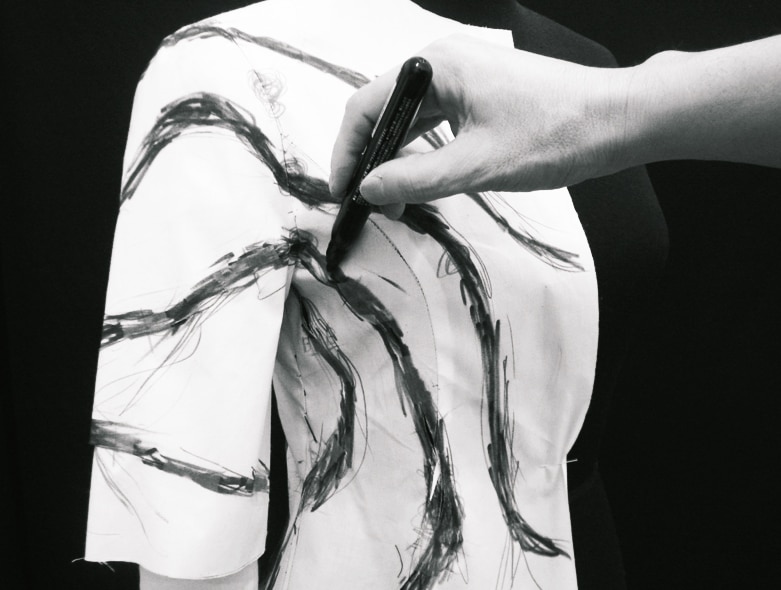
4.5 Manufacturing Methods
Integrating zero-waste design into mass production requires coordination between design and manufacturing. In conventional systems, marker makers optimise layouts for cost (Rissanen, 2022). In zero-waste practice, optimisation must begin at the design stage.
Grading presents challenges, as interlocking shapes may not scale evenly across sizes. This demands close collaboration between designers, patternmakers, and production teams.
Digital marker-making, laser cutting, and algorithmic layout tools support efficient configurations. Research indicates that integrated digital systems can achieve fabric utilisation above 98% (Ramkalaon & Sayem, 2020). As optimisation technologies advance, zero-waste layouts are becoming increasingly compatible with industrial production. At the same time, their geometric and modular aesthetics are now recognised as intentional design languages rather than constraints.
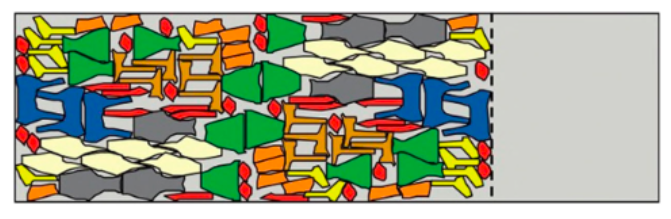
Image 10: Marker layout example (Bennell & Oliveira, 2008)
5. Challenges & Critiques
Zero-waste fashion design faces several barriers to wider industry adoption. One of the main challenges is unpredictability. Because zero-waste patternmaking requires constant adjustments across interconnected pieces, the final three-dimensional form can be difficult to anticipate. When translating a 2D layout into a wearable garment, designers may encounter inconsistencies in fit, proportion, or silhouette (ElShishtawy, Sinha & Bennell, 2022). While this openness can lead to innovation, it complicates replication and standardisation.
The shift from design to production also presents difficulties. Zero-waste methods depend on flexibility and collaboration, yet most fashion systems operate through linear workflows where design, grading, marker making, and production are separated. These rigid structures limit integration (Rissanen, 2022). In mass production, interlocking or tessellated layouts may not scale evenly across sizes, and complex pattern configurations can slow production, increasing costs and conflicting with priorities such as speed and volume.
Economic constraints further restrict adoption. Zero-waste design often involves experimentation and iteration, making outcomes less predictable and harder to standardise at scale (McQuillan, Rissanen & Roberts, 2013). This uncertainty contrasts with the efficiency-driven models that dominate much of the industry. Consumer expectations may also pose challenges, as unconventional seam placement or sculptural silhouettes may not align with mainstream preferences.
Finally, zero-waste patternmaking addresses material waste at the cutting stage but does not resolve broader structural issues such as overproduction, fibre impacts, consumption habits, or end-of-life disposal. There is also a risk of superficial application, where limited zero-waste elements are presented as comprehensive sustainability solutions. Without systemic change, such claims can contribute to greenwashing rather than meaningful transformation.
6. Future Directions in Zero Waste Fashion
Despite these challenges, several developments point toward promising future directions. Advances in digital patternmaking and 3D prototyping allow designers to simulate drape, structure, and fit with greater accuracy, reducing reliance on physical sampling (McQuillan, 2020). The integration of artificial intelligence into simulation and marker-making systems may further improve precision and material efficiency.
Regulatory frameworks are also evolving. Policies such as extended producer responsibility (EPR) and EU circular textile regulations encourage waste reduction and material preservation, creating structural incentives for zero-waste strategies. At the same time, material innovation supports new possibilities, including mono-material textiles, bio-based fibres, regenerative materials, and fabrics engineered to align with efficient pattern layouts.
Education plays a central role in long-term adoption. Zero-waste design requires integrated knowledge of patternmaking, material behaviour, manufacturing systems, and digital tools. Moving beyond strictly linear, sketch-first design processes toward exploratory and iterative methods can help embed zero-waste thinking more deeply in design practice.
Collaborative and open-source cultures further support diffusion. Practitioners such as McQuillan and Roberts have shared patterns, digital files, and process documentation, challenging the tradition of secrecy in fashion production. This openness encourages collective experimentation and knowledge exchange. As designers increasingly adopt non-linear creative approaches, zero-waste design may shift from a niche technique to a foundational component of a more responsible fashion system.
Key Insights
-
Zero-waste fashion design eliminates pre-consumer textile waste by integrating patternmaking into the earliest stages of design.
-
Historical garment traditions demonstrate that material efficiency is deeply rooted in global clothing cultures.
-
Zero-waste practice challenges the traditional fashion hierarchy by promoting systems thinking and collaboration between design and production stages.
-
Patternmaking becomes a generative design tool rather than a technical afterthought.
-
Techniques such as subtractive cutting, tessellation, jigsaw layouts, and transformational reconstruction offer multiple pathways to achieve zero waste.
-
Digital tools and AI-assisted marker-making systems are expanding the feasibility of zero-waste production at scale.
-
Zero-waste design reduces material waste but must be integrated within broader circular strategies to address overproduction and consumption patterns.
Summary
Zero-waste fashion design should not be understood as a constraint, but as a catalyst for innovation. By requiring designers to work within the limits of fabric dimensions and material efficiency, it reframes constraint as a creative driver. Silhouette, pattern geometry, and textile behaviour become interconnected elements of a unified system rather than isolated stages of development.
At its core, zero-waste design is both technical and conceptual. Technically, it eliminates waste at the cutting stage through integrated patternmaking and spatial reasoning. Conceptually, it challenges hierarchical and linear fashion workflows, encouraging systems thinking, collaboration, and iterative experimentation.
Zero-waste practice also reconnects contemporary design to historical garment traditions in which cloth was valued and fully utilised. By combining these principles with digital tools, material innovation, and evolving regulatory frameworks, zero-waste design becomes increasingly viable within modern production systems.
However, zero waste alone does not resolve the structural challenges of the fashion industry. Its greatest potential emerges when integrated with durability, recyclability, responsible material selection, and shifts in consumption culture.
Ultimately, zero-waste fashion invites designers to engage deeply with fabric, rethink established processes, and contribute to a more resource-aware and regenerative fashion system. Rather than limiting creativity, it expands it—demonstrating that material responsibility can generate new aesthetic, technical, and cultural possibilities.
References
Asia Stage. (n.d.). El Transformational Reconstruction de Shingo Sato. Retrieved October 28, 2025, from https://asiastage.mx/el-transformational-reconstruction-de-shingo-sato/
Bennell, J. A., & Oliveira, J. F. (2008). The geometry of nesting problems: A tutorial. European journal of operational research, 184(2), 397-415.
Binde, M., & Freimane, D. A. (2022). IS THERE A ZERO WASTE IN A FASHION DESIGN?. In DS 117: Proceedings of the 24th International Conference on Engineering and Product Design Education (E&PDE 2022), London South Bank University in London, UK. 8th-9th September 2022.
El-Dosuky, A. E. S. (2023). Using Transformational Reconstruction (TR) as a Technique for Developing Creativity in Fashion Design Education. International Design Journal, 13(4), 203-213.
ElShishtawy, N., Sinha, P., & Bennell, J. A. (2022). A comparative review of zero-waste fashion design thinking and operational research on cutting and packing optimisation. International Journal of Fashion design, technology and education, 15(2), 187-199.
McQuillan, H. (2020). Digital 3D design as a tool for augmenting zero-waste fashion design practice. International Journal of Fashion Design, Technology and Education, 13(1), 89-100.
McQuillan, H. (n.d.). Uncategorized – Page 4. Holly McQuillan. Retrieved October 28, 2025, from https://hollymcquillan.com/category/uncategorized/page/4/
McQuillan, H. (2019). Zero waste design thinking (Doctoral dissertation, Högskolan i Borås).
McQuillan, H. & Rissanen, T. 2011, Yield: Making Fashion Without Waste, exhibition catalogue, The Textile Arts Center, New York, USA.
McQuillan, H., Rissanen, T., & Roberts, J. (2013). The cutting circle: how making challenges design. Research Journal of Textile and Apparel, 17(1), 39-49.
Pingki, M. J., Hasnine, S., & Rahman, I. (2019). An experiment to create Zero Wastage Clothing by stitching and slashing technique. International Journal of Scientific & Engineering Research, 8(1).
Ratto, M., 2011, ‘Critical Making: conceptual and material studies in technology and social life’, The Information Society, vol. 27, no.4, pp. 252–260.
Rissanen, T. 2013, Zero-waste fashion design: A study at the intersection of cloth, fashion design and pattern cutting, PhD Thesis, University of Technology Sydney, Sydney.
Rissanen, T. (2022). Zero Waste Fashion Design in Fashion Systems. Sustainable Fashion: Take Action-with STUDIO, 87.
Roberts, J. (2021). Subtraction Cutting 2014-2020-131 Scholarly Encounters and Artefacts [REF 2021 Portfolio].
Waddell, G. (2004). How fashion works: Couture, ready-to-wear & mass production. Oxford: Blackwell Science.