

The fashion industry is going through one of the most complex moments in its history. Overproduction, textile waste, the accelerated obsolescence of garments, and the growing gap between sustainability discourse and actual industry practice have created an urgent need to rethink the system from its foundations.
With this as its starting point, students at HACER Creativo took part in late April in two collaborative working sessions run by the IMASUS project, focused on imagining possible futures for the textile industry and reflecting on the contemporary challenges of fashion and sustainability.
The workshop was structured as a hands-on exercise in research, debate, and creative design. In the first session, students received a set of challenge cards addressing specific questions around zero waste design, the emotional durability of garments, recyclability, and sustainable business models. Each student chose the challenge that interested them most and discussed their choice with others. From those conversations, four working groups formed, each developing a distinct line of inquiry.
The first group focused on monomateriality and how the use of a single material could simplify recycling and textile recovery processes. The second worked on end-of-life scenarios for garments and the real possibilities of recycling, questioning what happens to clothing once it is no longer used, with particular attention to closures and hardware. The third group explored the distance between sustainability discourse and the realities of production and consumption, trying to develop proposals grounded in how the market actually works. The fourth designed a business model built around ecological principles, using economic incentives to encourage more responsible consumption and production habits, articulated as a manifesto. These were the themes the groups debated; the prototypes that came out of the process took different directions.
The workshop addressed different areas of the industry: materials, design and production, recyclability, business, and marketing. The methodology started from conversation and moved toward conceptualisation, giving each idea a name and an initial identity before opening into speculative thinking: students visualised the ideal scenario for their proposal, mapped its potential improvements, and identified the risks and consequences of that vision of the future, with the aim of developing more realistic solutions and correction mechanisms.
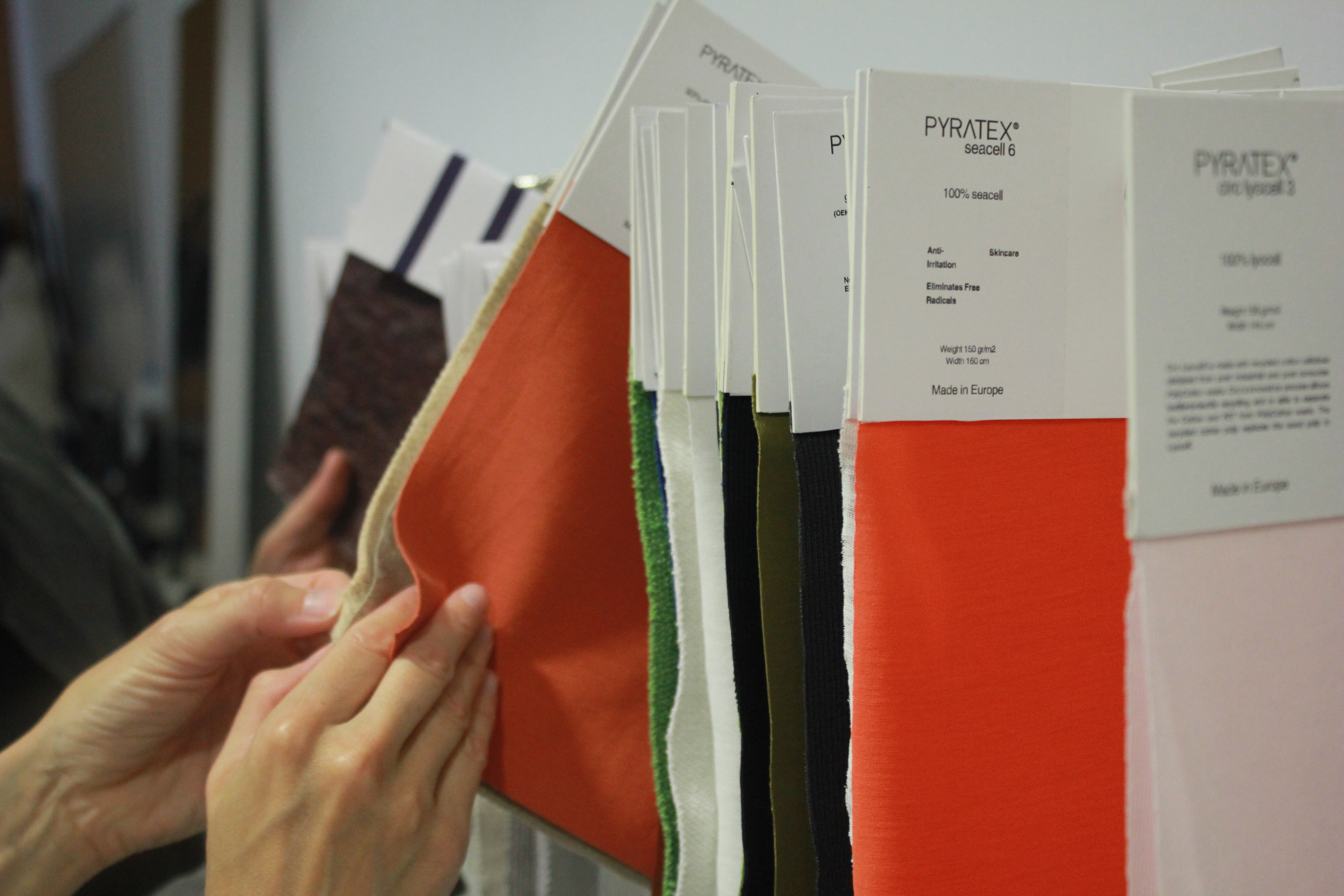
During the sessions, students also had access to the IMASUS materials database and the physical sample collection developed by researchers at INMA for the project. The database includes scientific characterisation of materials and SEM micrographs. This allowed students to better orient their ideas, explore possible applications, and examine the properties of innovative textiles made from fungi, hemp cellulose, cotton, tree bark, and plant proteins, many of them compostable and capable of replicating the properties of leather or even elastic fabrics like Lycra.
The experience generated concrete proposals, including modular and interchangeable garments, closure systems integrated directly into the material, and conceptual manifestos. It also opened a broader reflection on the complexity of the fashion system and deepened students’ understanding of sustainability. The workshop became an exercise in critical and creative thinking, offering tools and methodologies to plant a first seed toward more responsible ways of designing and producing fashion.