
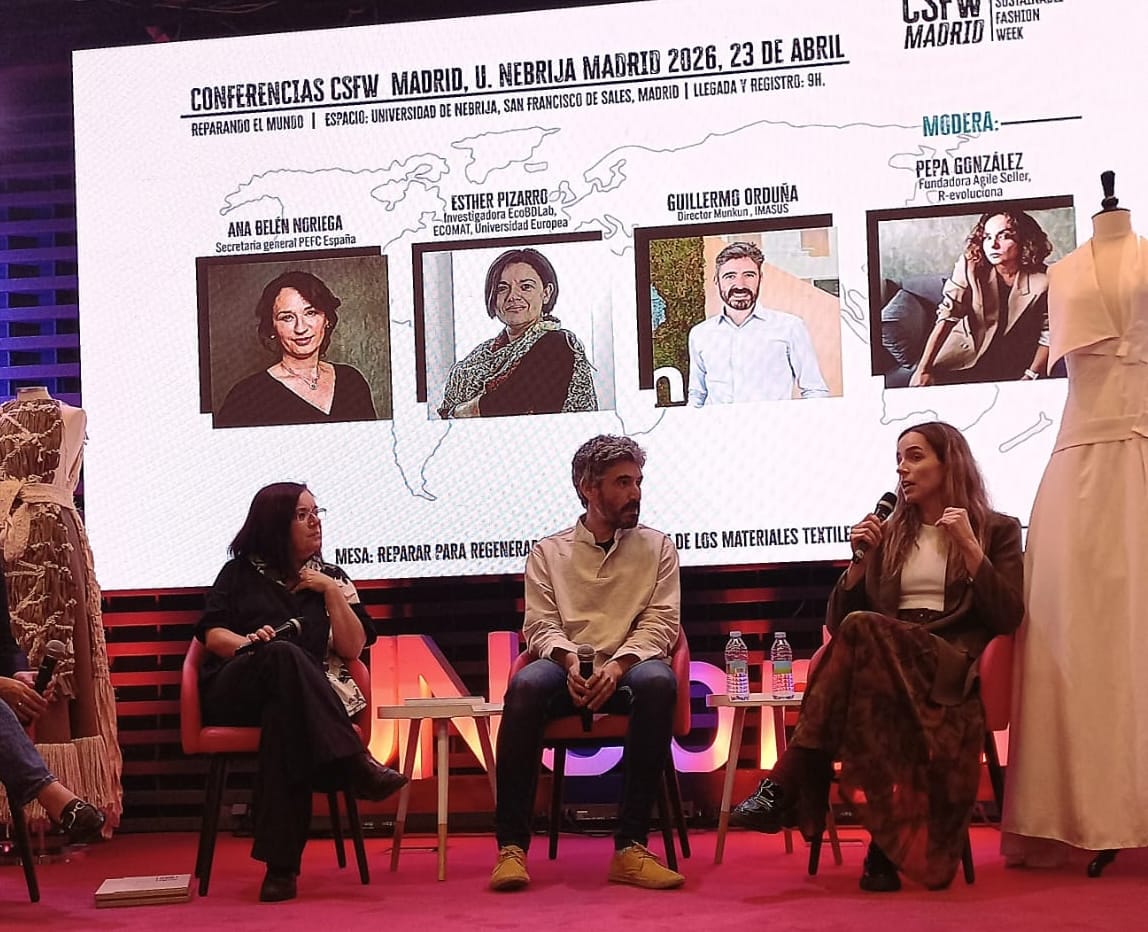
On 23 April, we were part of the Circular Sustainable Fashion Week Madrid 2026, presenting IMASUS at the panel on new materials and regenerative textiles. The event took place at Universidad de Nebrija in Madrid’s Chamberí district, a campus that starts telling the story from the gate: a cloister with a central garden, surrounded by labs and studios, corridors full of textile pieces in progress, the productive noise of artistic education. It was a different register from the research institutions where most of this work usually lives, and it helped set the right tone.
The morning opened with a panel on territory and textile heritage, moderated by Jorge López Conde, an architect from Boltaña in the Pyrenees who divides his time between Madrid and his hometown, works closely with the New European Bauhaus ecosystem, and brings a dual perspective that is rare in these conversations: the economic and cultural logic of rural territories, from timber to wool, seen through the lens of someone who genuinely inhabits both worlds. The conversation that stayed with me most was about wool. Luis Antonio Calderón Nájera, mayor of Paredes de Nava in Palencia, brought a number to the room. According to the most recent livestock census from Spain’s Ministry of Agriculture, cited in specialist press, the country’s sheep population has fallen from approximately 15 million animals in 2021 to around 10 million in 2025.
15 million sheep in 2021. Around 10 million in 2025. Five million lost in four years.
–Luis Antonio Calderón Nájera, mayor of Paredes de Nava
His municipality is home to one of only three functioning wool washing facilities still operating in Spain, the others in Mota del Cuervo and a nearby village in northern Castile and León. The problem is structural. After shearing, raw wool must be washed before it can be spun, dyed, or woven. The washing process generates effluent heavily loaded with lanolin, the natural wax present in raw fleece, which at industrial scale poses serious eutrophication risks. Regulation has tightened, many facilities have closed, and Spain now exports much of its raw wool rather than processing it domestically.
A cooperative of women that revived a local tradition of making traditional woven belts, adapting the model toward more equitable and community-led production, was introduce by Álvaro Ferrer (mayor of Portell de Morella in Castellón). The town gained sixty new inhabitants as a result.
What both mayors described was a coordinated effort between local government and community organisations to keep small-scale textile industry alive, building on existing structures rather than importing external models.
The responses already in motion across both cases were varied:
- filtration systems to manage the lanolin discharge
- compressed wool bricks tested as thermal insulation in Utrillas (Vitrolan)
- Mesa de la Lana a dialogue table bringing together rural representatives, industry, and government
For IMASUS, it was a live illustration of something we think about often: the challenge is not only the material or the technology. It is the full system around it, including the regulatory environment, infrastructure scale, and the economic conditions for small actors.
The design voices in the debate brought another dimension. Melina Salazar, from Peru, whose brand Metamorfosis produces garments from textile offcuts inside prison workshops, spoke about recovering a material her family had once been prohibited from using and eventually building a cooperative around it. Tatiana Teixeira, founder of AfroWema, a brand based in Kibera, Nairobi, that transforms recovered textiles into garments rooted in African cultural narratives, engaged directly with the wool problem: she drew connections to materials she works with and asked whether solutions found in one system could inform another.
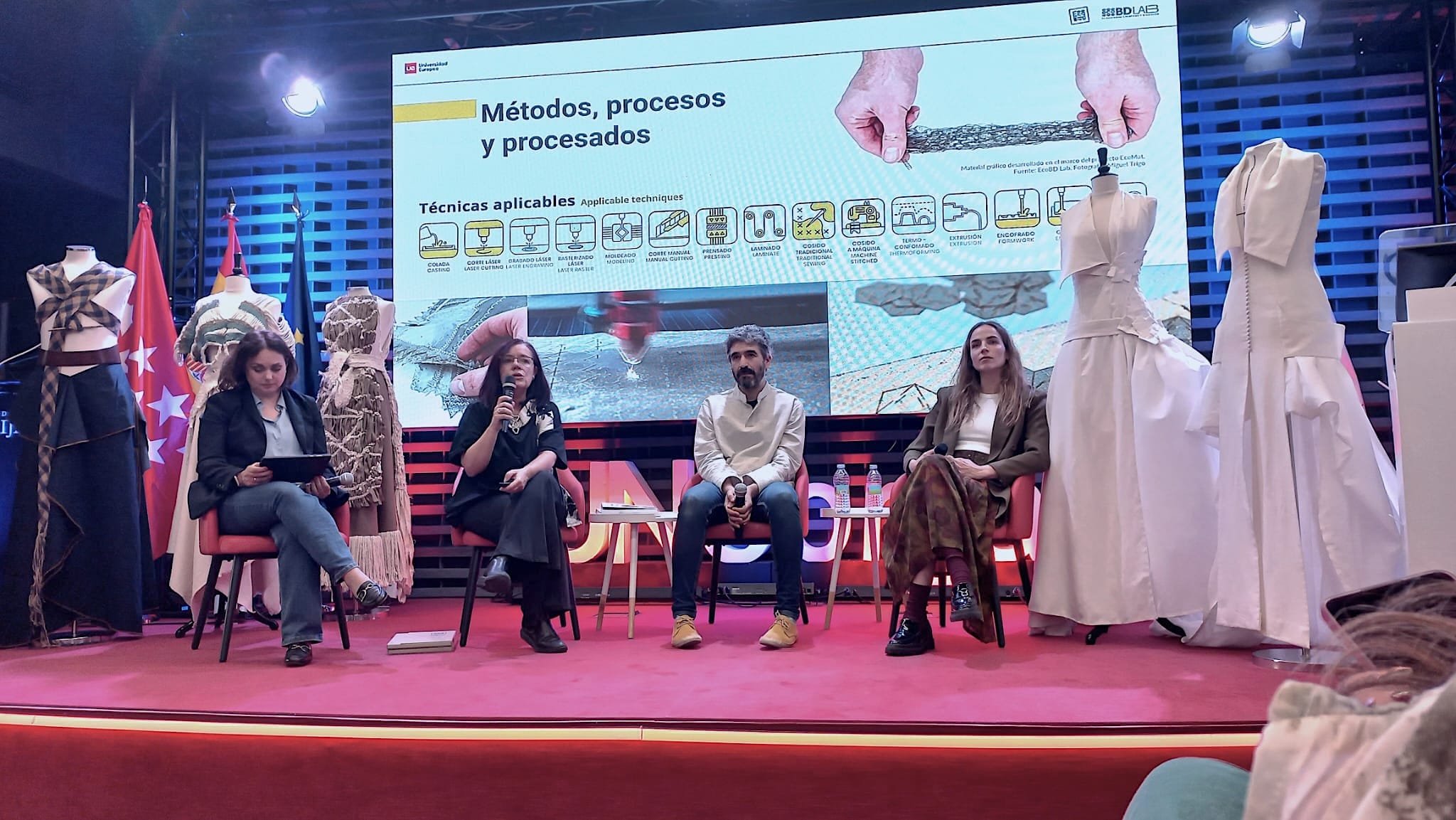
Our panel, “Repair to Regenerate: the new language of textile materials” was moderated by Pepa González of R-evoluciona. Esther Pizarro, researcher at EcoBDLab and ECOMAT at Universidad Europea, presented what she calls a materioteca: a library of 100 materials she has developed from natural residues and biological sources, including fungi, bacteria, flowers, agricultural by-products, and combinations such as wool and spirulina. She brought two of her own publications and two material samples to the panel. The room spent time touching them, smelling them, reading their characterisation sheets. It was a reminder that the scientific and the sensory are not separate in this field, and that the way materials are communicated is itself an argument for them. I also spent time with Esther Pizarro and her colleague Silvia, learning about two projects currently in progress. The first is an artistic residency in Toledo, where participants collect plants from distinct micro-ecosystems across a specific landscape and extract pigments from each to build a palette of natural dyes inseparable from their territory of origin. The second is a collaboration with a coffee producer, using the dried husks from cacao processing to develop a semi-transparent woven textile, currently being explored in layered garment pieces with their students.
Then emerge the case for forest-based textiles: fibres derived from sustainably certified wood, long associated with high-pollution processing methods. Raquel López Labiano, Digital Strategy and Textile Programme Manager at PEFC España, explained how the chemistry has changed. Modern closed-loop systems use minimal water and recover solvents throughout the cycle. The resulting fibres have distinctive properties: a specific drape, breathability, fall. Several of the materials she described overlap with materials we have analysed within IMASUS. It was striking to hear them positioned, credibly and concretely, for mainstream adoption.
I presented IMASUS in that context: our focus on closing the knowledge gap between material science and fashion education, the database of bio-based and sustainable materials we have been building, and the micrographs that make those materials visible at a level of detail that informs real design decisions. The interest from practitioners was direct. The database and the micrographs generated more questions than I had anticipated. I also brought a sample of the hemp-straw fabric from Wear Us, a project we have covered before on this blog, and several people came to handle it and ask about it.
After the programme, conversations continued. We met Itziar Martín Aresti, founder of Añino Merina, a brand that transforms Merino wool, including the native black Extremaduran Merino variety, into high-quality textiles, shoes, and accessories with full biological certification and traceability. She made a point that stayed with me: working with natural materials also means rethinking the narratives around durability. Products made from natural fibres may have shorter life cycles than synthetic alternatives, and communicating that honestly, not as a flaw but as part of a different relationship with objects, is itself part of the work.
The backdrop for the panels was an exhibition of garments from the previous year’s competition. Juana Montoya from Argentina showed work in dialogue with the criollo cultural codes and indigenous weaving traditions of the Calchaquí Valleys. Elena de Frutos reinterpreted the bridal dress using rectangular cut patterns and near-zero material waste. The physical objects made the conversation more grounded, and more honest about what these choices actually look like.
Days like this are rare. Finding a room where material researchers, rural mayors, policy officials, designers from four continents, and cooperative founders are talking about the same system from different positions is not easy. What the day confirmed for us is that the knowledge we are generating through IMASUS, about what bio-based materials exist, what they can do, and what stands between them and real adoption, is directly useful to the people working on this every day. The challenge is translation: between what is known in a laboratory and what is available in a pattern workshop; between what regulation now enables and what the market still needs; between a raw material disappearing from a rural landscape and a textile that could return it to value.