

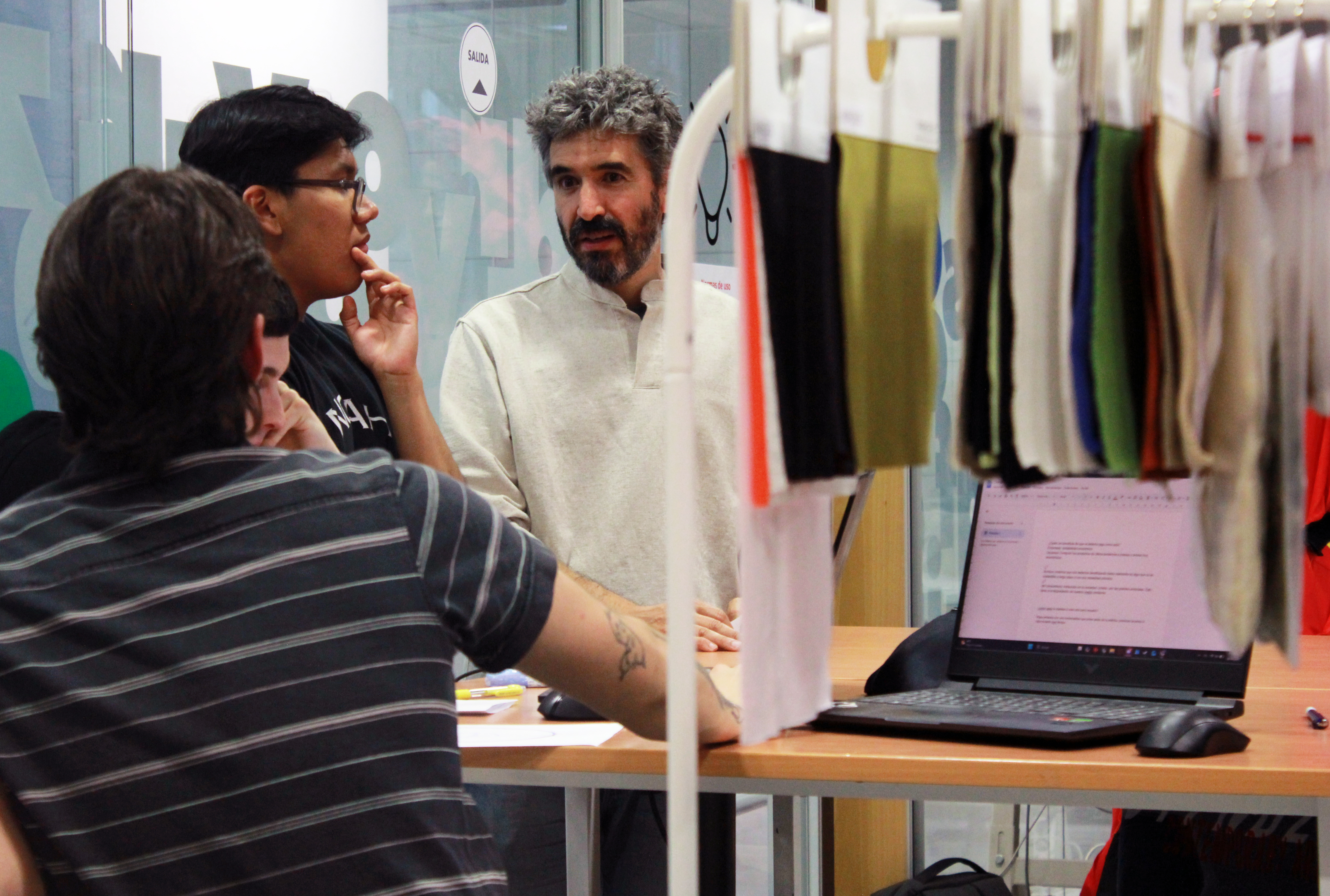
At the end of April, we ran the first IMASUS workshop with HACER Creativo in Zaragoza, in two sessions: a webinar first, and then an in-person session in the school’s studio space, a room with tall workshop tables, sewing machines along the back wall, and work from current students on display. It was a good setting for what we were doing.
Two groups of students took part: fourth-year students specialising in experimental pattern-making and third-year students from the materials, fibres, and textile structures module. The workshop uses the Imagineering framework developed by Diane Nijs at Breda University of Applied Sciences, which structures creative work into four stages: Appreciating, Breathing, Creating, and Developing.
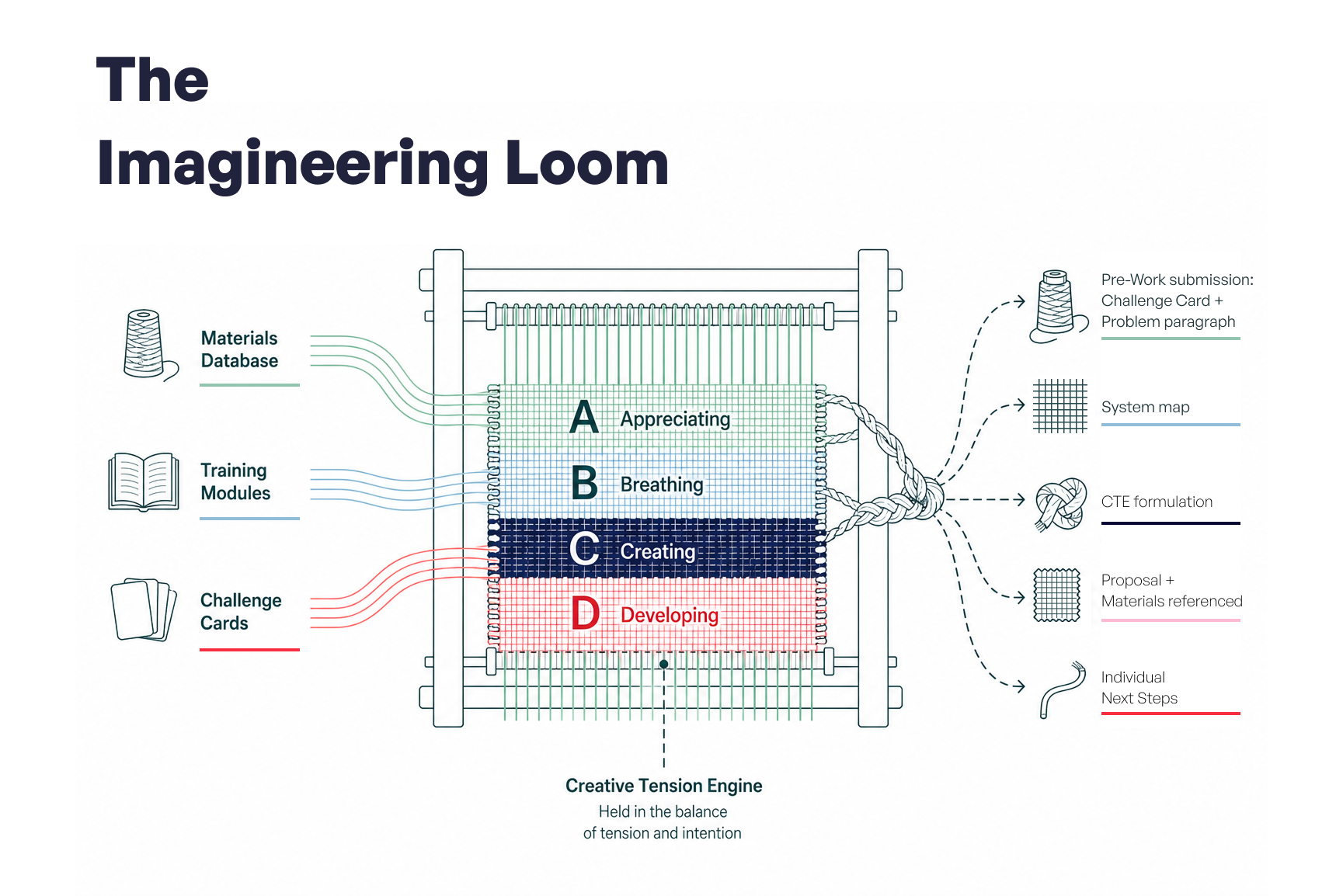
The first session, the webinar, covered the introduction and the Appreciating stage. We presented the four design lenses at the core of the IMASUS programme: zero waste design, design for recyclability, design for modularity, and design for longevity. Each lens came with case studies and an open question to carry. The Appreciating exercise asked students to surface what in their own experience gave them energy in relation to each lens, and to identify which of ten industry challenges they wanted to work on. The four challenges they selected were:
- How might we close textile material cycles at a regional scale?
- How might we align textile business practice with upcoming EU sustainability regulation?
- How might we improve traceability across textile supply chains?
- How might we reduce virgin-material use in textile production?
These formed the basis for four teams in the in-person session.
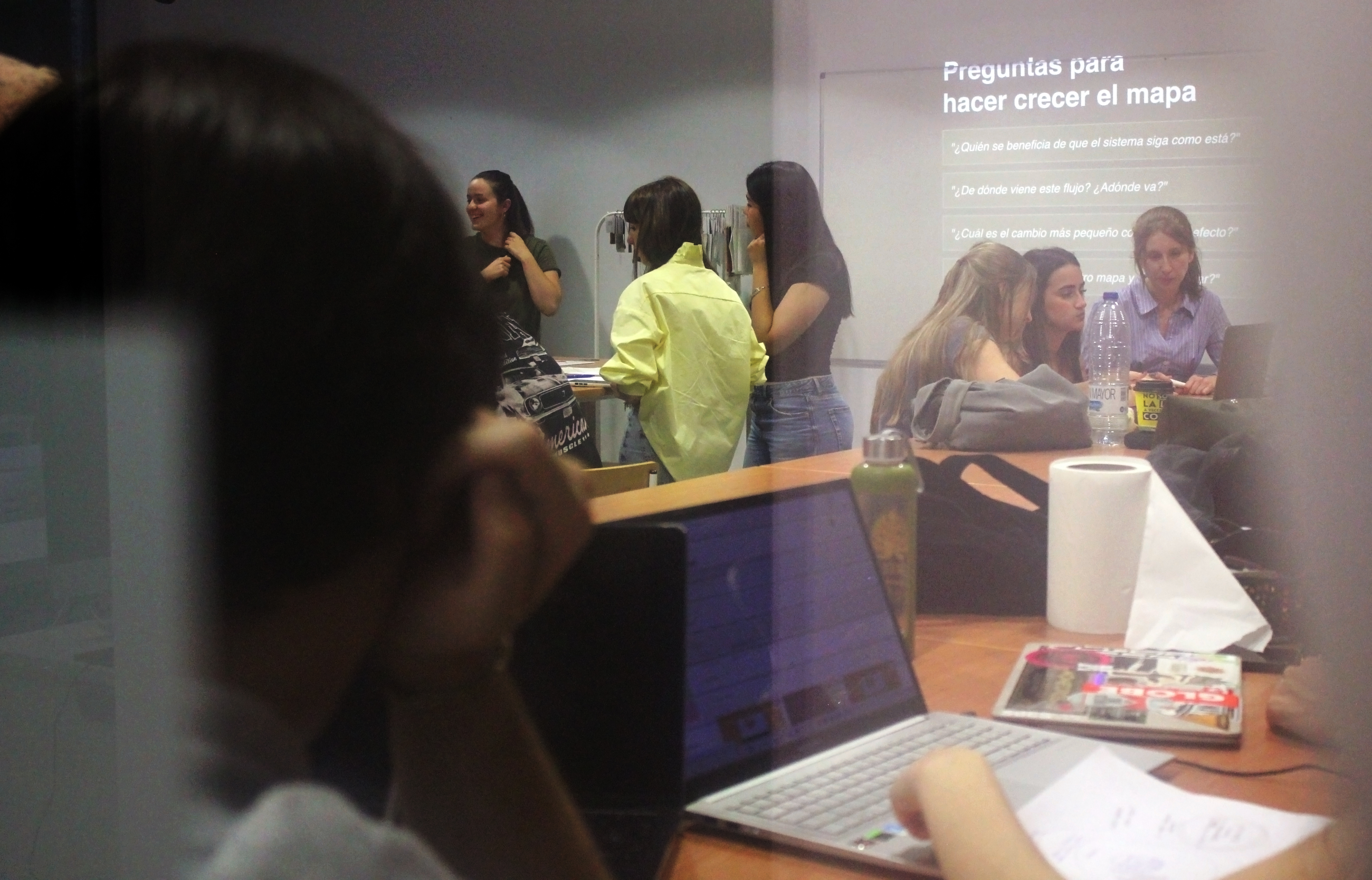
Breathing, the systems mapping stage, was the first real friction point. The exercise asks teams to map the actors in the system beyond the designer and consumer, identify material and money flows, and locate leverage points where small changes might generate movement. The questions it pushes, among them who benefits from the system staying as it is and what is missing from the map, were unfamiliar territory for most participants. Several teams hit apparent dead ends. The debate they generated getting through those dead ends was some of the most substantive work of the day.
Creating followed: each team formulated their Creative Tension Engine, a name, a promise, and a guiding principle for the change they wanted to make.
The team working on regional material cycles produced “Same but different”: a modular garment system in which pieces adapt to the wearer’s body and to seasonal change through gussets and buttons, sold separately and combined into new configurations. Guiding principle: the garment adapts to the client, not the other way around. They chose Pyratex Rewear 1 as the material for their prototype. We have previously looked at Pyratex textiles through the IMASUS materials database, and seeing a team reach for it independently to build a concrete proposal was a direct sign of the database serving its purpose.
The team working on regulatory alignment produced a manifesto addressed to Inditex. Their proposal: branded clothing collection containers as a channel between discarded garments and emerging designers, who would use the recovered material to create capsule collections that cannot be replicated. Their framing: “a business model that promotes consumerism no longer fits in a world that is running out.” The format was deliberately designed to reach the innovation and sustainability departments of a large fashion group.
The traceability team developed a university-industry collaboration model in which fashion design students work with a self-produced sustainable textile and pitch the result to a compatible brand. Their reference was SKFK, a Basque fashion brand with a transparent supply chain and a presence at 080 Barcelona Fashion Week. One team member had been developing the concept of a mango-fibre textile as the material proposition. The principle they identified: students learn from the industry’s perspective in order to design consciously and responsibly.
The fourth team, working on reducing virgin material use, proposed AIFF, an association for imperfect and functional training: a nonprofit dedicated to ecological education in fashion. Their model: workshops where participants learn to give a second life to discarded garments, making bags and accessories with design quality. Their Creative Tension Engine:
Greater appreciation for the imperfect when it is still functional.
The physical material samples we had brought were on the tables throughout the session, and touching them drew some of the strongest reactions of the day: an orange-fibre textile with an unexpectedly silk-like feel was one of them. Working with something tangible changed the work, and during Developing the proposals that had been system diagrams became more specific. Most teams ran out of time to take them all the way to a complete proposal in the session, and finished them afterwards.
The workshop has now concluded. After the session the teams kept working, completed their prototypes and documented their work in the IMASUS workshop archive for Spain. The published outcomes include C6 and Moon Pattern Making, which show how the workshop’s ideas developed into concrete proposals.